Sunday, October 21, 2007

Saturday, October 20, 2007
Juicy Couture...menswear, sizzlin' hot!


My eyes popped when I stumbled across Juicy Couture's full page ad in the weekend paper...
What a fashion statement, for menswear - at least!
Incredulous, I headed down to 450 Rodeo Drive to check out the haberdashery in person!
"Yeah, we're shaking things up in Beverly Hills," the handsome male retailer laughed, with a broad, winning smile.
The 6 foot model-type had the look himself!
His jet-black hair, with a fabulous sheen, screamed money; and, he was fashionably attired in a black "T" with shimmering, luminous images of skulls etched on the quality cloth, atop snug-fitting black jeans.
The label, known as Juicy Couture, is breaking out this fall!
Chic, well-designed jackets, with graffiti sprayed on the inside, and eye-catching details, were definitely luring my style sensibilities.
Juicy is a distinctive, virile look for men.
Some say, it's an edgy off-kilter look that's sleek.
Juicy notes,
"...you can add a little rock 'n' roll kick to your wardrobe without sacrificing the style. By pairing the right pieces, you'll be able to pull together a cool weekend look with loads of personality."
The eager sales rep noted that pop icons "Duran Duran" - friends of the two female owners - inspired the look.
In fact, the musical charmers will be donning the sizzlin' hot fashion ensembles right off their racks for an upcoming tour.
So, if you're aching to be a musical icon, a fashionista, or just on the leading-edge of "total cool", their threads are for you.
Affordable, too!


Friday, October 19, 2007
Matthew Shepard Act...hate crime bill passes Senate!
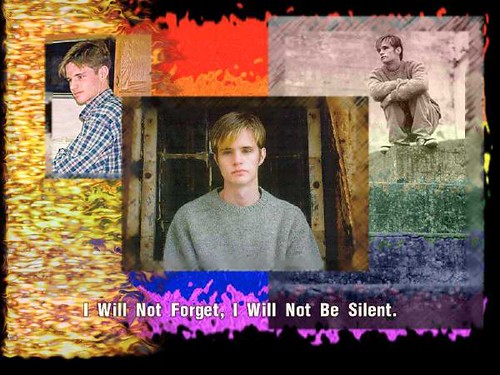
The Senate passed the Matthew Shepard Act which updates and expands the federal hate crimes laws to include bias motivated by violence based on a victim's sexual orientation, gender identity, gender, and disability.
By a vote of 60-39, the Senate ended a debate, conducted a voice vote, and attached it to an amendment to a Department of Defense Authorization Act.
Matthew Shepard's parents, founders of the Matthew Shepard Foundation, responded by noting they were humbled by the action on the part of the Government,
“Today’s Senate vote sends a bold and unmistakable message that violent crimes committed in the name of hate must end.”
“The Matthew Shepard Act is an essential step to erasing hate in America and we are humbled that it bears our son’s name. It has been almost nine years since Matthew was taken from us. This bill is a fitting tribute to his memory and to all of those who have lost their lives to hate.”
Matthew Shepard was a handsome young college student who was abducted, tortured, and left for dead (his broken body was tied to a fence for 18 hours) in Wyoming.
He died several days later.
Police say the motive for the crime was robbery.
But there was also evidence that the two thugs who committed this act were able to abduct Shepard by first posing as gay men.
The heinous crime caused controversy around the Nation.
In the wake of the brutal murder, liberal activists and interviewers on the morning news shows, teamed up to lay blame for the crime on the "Christian right."
According to one writer, Mona Charen, that this tactic was familiar did not make it any less outrageous or offensive.
She goes on to note that Gay-rights groups and their sympathizers in the broadcast media, seized upon the shocking murder to smear conservative Christians for creating a "climate of hate."
The reasoning behind this argument?
Apparently, a couple of months prior to the event, some conservative Christian groups had circulated print and television ads suggesting that it was possible to leave gay orientation behind, marry, and have children.
According to Family Research Council, one of the groups that sponsored the ads, thousands of men and women have successfully altered their sexual orientation.
The jury is still out on that!
The latest theory on "why gays are gay" suggests that birth order influences male sexual orientation.
According to new research by Anthony Bogaert, a psychologist at Brock University in Canada, gay men tend to have older brothers. Indeed, the more biological older brothers a man has, the greater his likelihood of being gay.
This leads Bogaert to conclude that a man's sexual orientation is influenced by the conditions in his mother's womb when he was a foetus; with successive male children triggering changes in the mother's body that increase the chances that subsequent male children will be gay.
This so-called fraternal gay birth effect creates a prenatal environment that fosters homosexuality in younger sons.
Intriguing theories!
Personally, I find another idea fascinating...whenever there is overpopulation in a species - it turns bisexual, or gay - to curb the problem.
Is man exempt from the laws of nature?
If the answer is no, perhaps the answers to "homosexuality" are waiting to be uncovered with expert research, here....
Henderson and McKinney, the young men who committed the murder, were not brought up on a hate crime, as no Wyoming criminal statute provided for such a charge.
The disturbing and brutal nature of Matthew Shepard's murder prompted calls for new legislation addressing hate crime, urged particularly by those who believed that Shepard was targeted on the basis of his sexual orientation.
As of that date, United States Federal law and Wyoming State law, dictated that crimes committed on the basis of sexual orientation were not prosecutable as hate crimes.
Therefore, in the following session of the Wyoming Legislature, a bill was introduced defining certain attacks motivated by victim identity as hate crimes, but the measure failed on a 30-30 tie in the Wyoming House of Representatives.
At the federal level, Bill Clinton renewed attempts to extend federal hate crime legislation to include gay and lesbian individuals, women, and people with disabilities.
These efforts were rejected by the United States House of Representatives in 1999.
In 2000, both houses of Congress passed such legislation, but it was stripped out in conference committee.
On March 20, 2007, the Matthew Shepard Act (HR 1592) was introduced as Federal bipartisan legislation in the U.S. Congress, sponsored by Democrat John Conyers with 171 co-sponsors.
Matthew's parents, Judy and Dennis, were present at the introduction ceremony.
The bill passed the House of Representatives on May 3, 2007.
Similar legislation passed in the Senate on September 27th, 2007.
It may be short-lived, however, since the White House has announced there will be a veto of the bill.
In the words of a White House spokesperson Dana Perino,
"We believe that local and State law enforcement agencies are effectively using their laws to the full extent that they can."
Can there ever be enough protection against Hate Crimes?
Maybe, when the senseless violence against individuals - gay, straight, or transgender - stops...
Gone Baby Gone...a morality tale! Admirably directed by Ben Affleck...
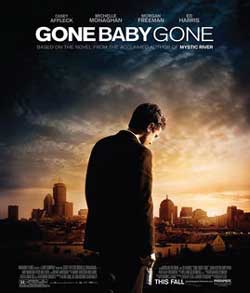
Opening narratives normally turn me off, but in the case of the feature film - "Gone Baby Gone" - the device worked quite effectively.
While the dialogue was a bit preachy as the opening scenes unfolded, undoubtedly, it was Casey Affleck's insightful interpretation of the scripted material that touched a chord.
In sum, his voice evoked a ring of truth which resonated.
One critic noted that Ben Affeck's directing debut on "Baby" was a bit rough around the edges. True.
But, just maybe, he was going for that natural Independent film look without all the slick Hollywood touches.
With a delicate hand and a keen eye, Affleck ushers us into the heart of the story without much fuss or bother.
A young woman's daughter has gone missing.
Without a ransom note - and after a police investigation for three days on a cold trail leads to dead ends - an aunt approaches a young gumshoe (played capably by Casey Affleck) to poke around the neighborhood for clues.
Affleck's character was raised in the area and has inside associations with the locals - so when police leads turn cold - the distraught woman turns to the private dick for help.

With his pretty baby face - and naive demeanor - he appears to be an unlikely candidate for the task. But, when it comes to a crunch, he holds his own admirably.
As he swaggers into the underbelly of the hood, he mixes and mingles with a cast of colorful distasteful characters.
Some individuals would throw up their hands in disgust and retort "white trash".
For sure, casting could have been conducted on the Jerry Springer show.
Actually, Affleck pulled people from the streets to play a handful of small parts in the intense drama.
Hitchcock often cast minor roles with relative unknowns. The legendary directory felt that if an actor's face was less familiar to the audience, it may lend more realism to the film.
It works here!
A lot of the language is pretty foul (raw) with no holds barred.
And - as the story progresses - the bizarre twists and plot turns become a little convoluted!
It's a sordid tale about child abuse, dirty cops, and a slice of life that middle America would prefer to cast a blind eye to.
Some judicious editing would have tightened up the project somewhat.
But, this being Ben's first "baby", he goes all out (what the heck).
When it's determined that the child has not really been "kidnapped" at all, but taken to "save her" from her from a squalid existence, the piece becomes a morality tale.
A question arises.
 Should the child be returned to the rightful parent - an immature drug-addicted selfish one - or stay with a family that will provide a loving home and the needs of life?
At this juncture, the floodgates opened for me.
I suppose, I have a confession to make.
When I was seven years old, a strange man came up to me on the street outside my elementary school - addressed me by name - and then asked me one question.
"Are you happy?"
For the life of me - to this day - I can't recall my response.
The next day, he reappeared on a mission.
After my clothes were packed into little bags, he bundled me up into a late model car parked out front.
As we drove off, I stared out the window and caught the distressing image of my mother standing on the stoop, wiping the tears from her eyes.
Although the details are still a little vague, I recall being taken into a small courtroom; then - with little more ado - I was made a ward of the State.
In moments, I was whisked away to a quaint little house in the suburbs, where I was placed in the care of a pleasant elderly couple.
A few days earlier - a couple of my mother's friends had been involved in a drunken brawl - which resulted in a serious injury to one man's head.
In what seemed like seconds, in a nightmarish turn of events, police and medics swirled all around the humble little dwelling, as the authorities tried to resolve the issues.
After an urgent plea from distant relatives and neighbours, child welfare was inclined to release me from my Mother's care, and place me in the custody of the State.
There's a line in the film:
"You are who you are because of where you haven't been."
Over the years, I have reflected on the past, and occasionally it haunts me.
Would I be the same person I am today, if I had not been transplanted from my "roots?"
Although I was nurtured and given the necessities of life - schooled, taken care of physically, mentally, and emotionally - sometimes I long for my youth.
There is no substitute for a Mother's love...
Thursday, October 18, 2007
Things We Lost in the Fire...a script, for this abysmal bore of a film!


There is only one reason to purchase a ticket to take in Dreamworks' new feature, "Things we lost in the fire": Benicio Del Toro!
From the moment he saunters on the screen, in this Halle Berre vehicle, every fibre of his being resonates; in essence, his performance is a work of art - a revelation!
In this overly-long drama, he inhabits the persona of an addict with such remarkable precision - and insightful, almost intuitive imaginings - that one sits mesmerized in the theatre spellbound, riveted by each gesture, nuance, and facial expression.
Essentially, the tale is about a woman, Berre - perhaps, more on this later - who loses her husband in a senseless killing and her subsequent struggle to regain her momentum once again in life...
Enter, Del Toro, a lifelong friend of her husband, who arrives at the funeral somewhat disheveled, but coherent.
On the verge of recovery, with monumental problems of his own, he sets aside his own yearnings in a concerted effort to not only heal her wounds, but give much-needed guidance to her two young children, struggling in the wake of the tragedy.
But, conflicts - some needless, others realistic - rear their ugly head, and interfere.
Suddenly, the stress of an unexpected confrontation sends Del Toro's character headlong into a relapse and straight back to the gritty back alleys, where desperate users burn their bridges and seek solace in a forlorn "shooting gallery", off-the-beaten track.
At this juncture, the film shifts gear full throttle, and focuses on Jerry's efforts to come clean.
That is one of the major problems with the film...
When the opening scenes for "Things we lost in the fire" unfold, for a moment or two, the audience is under the impression the tale is about Ms. Berre's character.
But wait, as flashbacks spin out on the screen, it suddenly appears that we're mistaken; perhaps the drama is all about her husband, played by David Duchovny (who phones in his role), and some deep dark secret?
When it appears the film is gaining footing, and forging ahead in some logical direction, suddenly - "Fire" shifts a gear - then puts the spotlight on the children and their erupting, emotional problems.
Essentially, the audience is confused at this point; after all, the scripted tale is spreading out in all directions, without any center or focus...like a ship, without a rudder.
The Director, Susanne Bier, must have been a still photographer in a former incarnation, because on this project...she needlessly lingers on intense, up-close eyeball shots, and frames half-lit faces - yes, evoking moods, but without making any coherent sense.
Frankly, this filmgoer couldn't fathom what she was up to...
Ha!
When I start to pay tribute to the furniture, I know someone is in trouble.
How would I sort out this mish-mash mess of a film?
Well, for starters, flashbacks of Duchovny would be kept to a minimum.
In addition, I'd bestow a respectful period of mourning...then, move on.
In my version of "Things we lost in the fire", the lens would zero in on Del Toro's addiction, and Barre's altruistic efforts to help him come clean - in loving memory of her husband, perhaps?
In its current skin, the audience can only pray that everything goes up in flames again...and, that Del Toro is the lone survivor - well, maybe with the kids in tow, too.
Halle, what were you thinking when you signed on for this project?
No Oscar buzz here, for you...
For Benecio, yes!
Subscribe to:
Posts (Atom)

