3
Showing posts with label Allen Ginsberg. Show all posts

Sunday, April 10, 2011

Jack Kerouac..."Beat Atlas" chronicles author's haunts! San Francisco library event!


Fans of Jack Kerouac have probably taken a trek around North Beach to retrace the footsteps of one of the beat generation’s most celebrated personalities.

The author of “On the Road” – yet to be adapted for the big screen - kicked around San Francisco’s bohemian artsy-fartsy neighborhood on the edge of Chinatown with pals like legendary poet Allen Ginsberg (Howl) during the heady days of his sky-rocketing fame in literary circles.

Today, the Jack Kerouac Museum on Broadway, exalts the writer to cult status by virtue of its extensive collection of memorabilia and a bevy of publications - great and small in stature - which have painstakingly chronicled every fascinating chapter of his life in minute detail.

Although the territory has been fairly well-documented to date, Kerouac fans may be interested in attending an upcoming event slated for April 26th at the Main Library in downtown San Francisco

Author Bill Morgan will discuss his latest book the - “Beat Atlas” - which takes a state-by-state look at the haunts Jack Kerouac and his buddies frequented on their infamous trek across the country which was subject matter for Kerouac’s notorious best-seller.

For example, Morgan not only reveals the park where Kerouac hiked in “Dharma Bums”, but also tosses the spotlight on the location where Ginsberg first read his controversial poem which landed him in court on obscenity charges.

Readers of the Tattler may recall that I penned a post on Kerouac, Ginsberg - and their merry gang of followers (poets, artists, political activists) - on a prior trip to San Francisco.

Post: 02/11/2008


http://ijulian.blogspot.com/2008/02/jack-kerouacbeat-museum-characters-of.html

Post: 09/05/2010

http://ijulian.blogspot.com/2010/09/howllife-times-of-allen-ginsberg.html

Whether Mr. Morgan manages to turn up anything delicious intriguing (or enlightening insightful) tidbits to gobble up – at this juncture – remains to be seen.

If not, he may have to re-title his tome, the “Road Well Travelled”!

But, I applaud the ballsy effort, nonetheless!

http://www.thetattler.biz


Monday, October 18, 2010

James Franco...drag pose for CANDY magazine! Oh, darling!


And, you thought that actor James Franco was a handsome uncomplicated screen idol!

Imagine that.

The versatile performer - blessed with an engaging twinkle in his soft brown eyes and inviting full lips - is inclined to traipse the-light-fantastic in heels and high-drag.

Uh-huh.

That’s the "MILK" star currently posing on the cover of CANDY magazine passing himself off as a luscious femme fatale with an enticing come-hither look that any self-respecting trannie would die for!

You go, girl!


Franco portrays Allen Ginsberg in "Howl"

Sunday, September 5, 2010

Howl...Life & Times of Allen Ginsberg! Screens @ Roxie!


Because I came of age in the late sixties, I was able to follow Ginsberg’s celebrated antics as they splayed out in that heady - at times turbulent - era of political activism.

In addition to his outspoken controversial views on "Big Brother" - and issues related to intellectual freedom and the right to unchecked artistic expression in the land of the free - the well-educated writer also sought acceptance for homosexuals long before the term “gay” had ever been coined.

For this reason alone, young men and women of the same-sex persuasion, should hustle over to the Roxie theatre to catch a documentary on his life, with the ultimate aim of paying homage to a free (but troubled spirit) that helped pave the way to tolerance.

There were many highs-and-lows in his remarkable life.

Mostly up, though.

Ginsberg was not only in top form when he attended the Chicago 8 trial back in the sixties - but in his element - when he stridently marched through the “politically-charged” streets alongside a mob of angry protester's in a highly-volatile moment in U.S. history.

As the frenzied media scrambled to document the unprecedented events running rampant in the mean streets of Chicago - which appeared to be rooted in revolutionary anti-establishment philosophies - many shocked Americans around the Nation became familiar with the outspoken poet for the first time.

“Pinko fag,” was the cry of the day!

Years later, in the documentary “Chicago 10” - a filmmaker strategically embedded a handful of potent news clips of Ginsberg into the footage - to underscore the Beat poet's  important contributions to the cause.

Chicago 10
Movie Review

Post: 02/28/08

http://ijulian.blogspot.com/2008/02/chicago-10documentary-distorts-truth.html

Although I was not inspired to join in with the dedicated political activists of the day, I casually observed from the sidelines without venturing too close to the Ginsberg gang.

I was influenced by Ginsberg’s creative sensibilities, though.

When I flipped open an artsy-fartsy copy of “Howl” in a bookstore one day at the tender age of 16 (at  Coles in downtown Toronto) - and read a couple of stanzas out-of-the-blue - my heart raced.

Understandably.

In plain unadorned English, Ginsberg wailed passionately on the page.

“Your cock is holy! Your ass is holy”

It wasn’t until a couple of years ago, that a series of synchronised events prompted me to delve into the persona of Ginsberg, during a brief stay in North Beach (San Francisco).

One night, I stumbled across a “Jack Kerouac”celebration at the “Beat Museum” (stocked to the rafters with intriguing memorabilia) on Broadway in the heart of the red light district, and the proverbial door opened wide.

Though familiar with the best-selling classic “On the Road” - and its impact in Literary circles when it was first published - background on the writer’s merry band of friends eluded me over the years.

Now, I rested comfortably on a perch surrounded by Kerouac pals and relatives, as they shared intimate moments with rapt fans.

One enthusiastic stranger in attendance informed me that there was going to be an upcoming  live performance of Howl staged at a local Cultural Center downtown in the near future.

So, I snatched up the info, and made a beeline to catch the much-ballyhooed event on the night in question.

For those of you in the dark, it should be noted for the record, that “Howl“ ended up being the author’s profoundest most-celebrated works of poetic fiction.

In part, the lofty accomplishment was due to the fact the poem was at the heart of a landmark legal proceeding, that ultimately tested obscenity laws in the highest U.S. courts.

I penned a review on the theatrical event which was a triumphant success.

Post:  02/13/08

http://ijulian.blogspot.com/2008/02/howlginsberg-controversy-recalled.html

Tonight, as I skirted faceless strangers and silently slipped along the Broadway strip slightly out-of-reach, a sea of emotion swept over me

As a canopy of stars started to play hide-and-seek with a mystical fog that wafted in off the inky-black bay, it dawned on me that Ginsberg and Kerouac once strode this well-worn path - too - in kinder gentler days.

Meanwhile, the “Beat” museum stands a living memorial, that keeps the memory of Kerouac and his cohorts alive.

As I sip on a can of Mike’s Harder Lemonade, and toy with a turn-of--phrase or two, I am humbled by the legacies Mars. Kerouac &  Ginsberg left behind.

Indeed, after God created Ginsberg, he broke the mold.

This weekend intend to take in the documentary - "The life & Times of Allen Ginsberg" - for good reason..

With the upcoming feature film "Howl" (starring James Franco) on the horizon, now may be a good time to catch up on Ginsberg trivia.

The doc screening locally was directed by Jerry Aronson (academy award nominee) and follows Ginsberg from his youth, through the Beat Generation of the '50s (when he initially wrote "Howl"), his political activism in the heady 60's, and into old age.

See 'ya there!


James Franco plays Ginsberg in upcoming "Howl"

Sunday, January 10, 2010

Sundance Film Festival...Howl screens in San Francisco! January 28th...


James Franco portrays Ginsberg in HOWL!


This year, San Francisco will participate in a newly-introduced facet of the Sundance Film Festival, to celebrate Independent filmmakers.

On January 28th, the film HOWL (starring James Franco) will screen at the Sundance Kabuki.

Over the past two years, festival organizers in Park City (Utah) have been forced to face the bitter reality that their fest is not as popular or relevant as it once was on the circuit.

I expect this twist is a last-ditch effort to bolster its image under the guise of reaching out.

For me, the announcement was somewhat synchronistic in nature.

Last year when I was in town (I've vactioned in the Bay area over the years since 1972) I attended a remarkable stage performance of HOWL which was produced locally and garnered a lot of critical acclaim.

And, at the Jack Kerouac museum in North Beach, I met a handful of Allen Ginsberg's friends - which prompted me to research and pen a post on HOWL, Ginsberg, and a gang of renowned writers - who used to hang out in North Beach during the "Beat" era.

Post: 02/13/08

http://ijulian.blogspot.com/2008/02/howlginsberg-controversy-recalled.html

I feel a bit of a psychic bond with Ginsberg, too, because of an eerie coincidence.

When I first conceived my concept for my blog, out-of-the-blue, the name "Tattler" kept bouncing around inside my head as I toyed with conceptual ideas and my subsequent vision for the blogosphere entity.

The "Tattler" stuck and has been growing in leaps and bounds ever since.

Curiously, when I was deep in my research on Mr. Ginsberg, I was startled to discover that the celebrated author was once the editor of the school newspaper - The Tattler - at Columbia University.

Was the openly-gay artist influencing me from the spirit world?

This inquiring mind wants to know!


Thursday, February 28, 2008

Chicago 10...documentary distorts truth. Just the facts, man!


Were the protests at the 1968 Political convention headed up by a band of Yippies symbolic of the conflicts of values that characterized the late sixties?

In Chicago 10, a film screened at the California Plaza recently, a rapt audience watched in awe and disgust as the documentary of the alleged events of the 1968 Political Convention in Chicago, unfolded on the screen.

Adeptly facilitating an ambitious mix of CGI animation and archival footage, Director Brett Morgan chronicled the events surrounding the incident where protesters denied permits to demonstrate, repeatedly clashed with police, and the most vocal perpetrators - Abbie Hoffman, Jerry Rubin, and others - were prosecuted eight months after the melee, pursuant to the Anti-riot Act.

The documentary has been being billed as a parable of hope, courage, and ultimate victory.

It is far from that.

Actually, it's a cautionary tale about clashing wills, human error, and blind ambition - all rolled into one.

True, some of the images are shocking - close-up shots of cops beating on peaceful demonstrators - definitely not for the squeamish.

As the character in the film - "Cool Hand Luke" - said, "What we have here is a failure to communicate".

There were a number of glaring mistakes made on both sides.

For instance, the City of Chicago should have granted the permits; after all, denying peaceable assembly in the U.S. is un-American.

But the Chicago 8 and their merry band of followers erred too; the hapless protesters should have vacated the park at 11 p.m., and postponed the event, until the proper permits were secured from the city.

Although everyone was rooting for Hoffman - myself included - it was painfully obvious from the footage that he and Rubin acted immaturely, stupidly.

What adult or teenager is not painfully aware of the consequence of disrupting a courtroom?

None of their antics in his Honor's presence or the judicial environs contributed to the cause at all.

Yes, the Judge acted outrageously. But a complaint to the Commission on Judicial Performance, or a petition for removal from the bench - even a request for change of venue - may have been the right way to go.

Yes, Judge Hoffman (no relation to Abbie) erred, too.

Instead of denying Bobby Seale (Co-Chair of the Black Panther Party) his right to represent himself without explanation - the court would have been wiser to have followed one of two courses of action: either warn Seale about the perils of self-representation, then permitted the defendant to proceed if he elected to do so, or - taken the matter under submission, written up a legitimate ruling, citing the valid points of law, then duly noted for the record that Seale was entitled to appeal the ruling in the proper forum.

Instead, we witnessed Seale being gagged and bound to his chair after his wild, disruptive protests about rights' violations aggravated the Judge...probably one of the most shocking and blackest moments in American History.

There were a number of humorous moments in the film, too.

For instance, Allen Ginsberg appeared on the witness stand and was asked by a prosecuting attorney to explain his use of a word referred to as "um" which he used to relieve tension.

Later in the film, when the demonstrators were facing a tense situation in the march, Ginsberg is seen emoting "um" into a loudspeaker - which was hilarious.

Anyone practicing Buddhism or Yoga will confirm that the sound of "om" should be a joyous sound, one that connects with the inaudible life stream; in this instant case, it was more like an off-key drone from an old test pattern on a fifties-style black and white TV.

One viewer thought the documentary was "too gimmicky".

For example, the director used CGI animation to depict the courtroom scenes.

The effect, in my estimation, was very effective for one reason: it suggested the drama unfolding in the courtroom was cartoon-like, unreal - compared to the brute reality of the archival footage of the street - where heads were being cracked and bodies were being dragged into paddy wagons.

Another moviegoer pointed out that there were two events, actually.

First, there were the demonstrations at the 1968 Political Convention, then eight months later, the trial of the Chicago 8.

The way the footage was edited, reality was blurred - which poses the question - was this a clever manipulation by the director?

In fact, when a woman asked in the Q & A what his response was to claims that his movie was "agitprop", for the first time he squirmed in his chair, was at a loss for words, and struggled to respond.

As a character recently said in the movie "The Year of the Dog" - “guilty".

My Art Professor told me once that when you view a work of art - be it a painting, or a film - that you must first step back and determine first what it was that "washed over" you.

In this instant case, the director used his editorial control, and seductive images, to manipulate history.

Just the facts, man.

Please Note:
This review was written several months ago before the producers secured distribution. I have re-posted the item in view of the fact wide-screen release is slated for Friday, February 29th, 2008.

Wednesday, February 13, 2008

HOWL...Ginsberg controversy recalled! Ferlinghetti & Friends theatrical event!


Allen Ginsberg and lover Julian Beck bare all for Art


The last time I was in San Francisco, it was a joyous swirl of synchronistic moments, divine connections, and mystical moments.

One night, I found myself in the thick of the Ginsberg legend - not surprising - since a day earlier at an auction at the “Beat Museum” (North Beach) copies of “HOWL” triggered old memories.

Then, on the heels of that awakening, I came across a thick biography on Ginsberg steeped with insightful glimpses into the poet’s mystical soul.

Go figure!

After stumbling across a notice in the San Francisco Chronicle (which announced a reading of “HOWL” at the Yerba Buena Center) I ended up front-row center and inexplicably drawn to a reading of the controversial piece.

A tough assignment.

As three Poet Laureates wrestled with their interpretations of the remarkable literary work, Ginsberg’s profound musings - each carefully crafted word from all the astounding passages - bounced onto a screen behind and revved up the underlying theme.

Devorah Major’s voice was raspy and brimmed with rich full tones.

She performed her piece in a precise measured manner - which was effective for the most part.

But somehow, “Howl” - in a woman’s mouth - jarred the sensibilities somewhat when they tumbled out.

A second poet, Jack Hirschman, tackled his lines with great gusto.

For the most - the sharp punches he punctuated ‘em with - managed to hold the crowd’s collective breath in his thrall.

Overall, though, the interpretation was uneven, not very-well modulated, and lacked variety.

In sum, his interpretation was weak, ineffective, and uninspired.

The potent lines he delivered up deserved a better voice.

That of a seasoned actor, such as Richard Burton, perhaps.

The third woman - Janice Mirikitani - lacked the insight, depth and mere talent (even the imagination)to pull off the theatrics of “Howl”.

Her segment ended flat. I felt embarrassed for her.

Obviously, none of the readers had done their homework.

When Ginsberg wrote “Howl” - some passages were meant to resonate with an authoritative prophetic tone - which none came close to fathoming last night.

A handful of verses meant to be - “long litanies of sympathetic proclamations” - droned on senselessly without spirit or worthwhile inclination.

A ladder structure - the work of the long line - was not explored either, sadly.

Not did the - “barely in-control feeling of the Cassady word-rap” - come to life.

In fact, there didn’t appear to be any understanding of - “The beauty of abstract poetry of mind running along making awkward combinations like Charlie Chaplin’s walk, with long saxophone-like chorus lines…” - as originally intended by the author.

The rhythm, syntax, and diction that was painstakingly penned to effect an even and elastic flow from verse to verse was missing here.

But, what a footnote!

A young Afro-American male (Kahlil Anthony) started off by mimicking a jazz riff - while a young gospel-style singer sang - “Holy”, “Holy”, “Holy” - soulfully, almost reverently, at intermittent moments.

Then, the charismatic youth began to spout words.

Indeed - searched for ‘em one instant - experienced their wonder the next.

I marvelled at his reach and thrust.

As words trilled off the tongue - at first - he joyfully teased the audience as he hit the highs and the lows.

Then, the talented artist dove deep into the inner recesses of his soul.

Awesome!

In the midst of the staging, I imagined Ginsberg’s own delightful probe.

In essence - Kahlil’s performance of the “footnote” - was a startling entertaining ten or fifteen minutes of theater that brought the piece to life.

Ginsberg would have given a nod of approval, I’m sure.

Interesting, how the night came about.

According to Ken Foster (Director of the Yerba Buena Arts Center) respected artist Lawrence Ferlinghetti approached him about hanging a half-a-dozen paintings in the gallery which were rejected for display at another institution on the grounds that they were “offensive”.

At that meeting - the forward-thinking Foster suddenly recalled a local radio station also bowed out of an opportunity to present an on-air reading of “HOWL” in recent weeks - for fear of reprisal from the FTC for obscenity.

The confluence of the two events crystallized ideas that he had been mulling over in respect to the role of the artist and a gallery in the community.

It suddenly occurred to Foster that this was the perfect occasion to throw together a multi-media theatrical event with the express purpose of making a bold-faced statement about “freedom of expression”.

“We want to show work that is meaningful to a contemporary world, but sometimes artworks are controversial due to nudity, sexual situations or violence,” he noted in an essay published by “FORUM” at the San Francisco Chronicle.

Gallery officials (such as himself) were often forced to become gatekeepers, he complained.

Indeed - at the risk of not offending - Foster astutely conjectured it was wholly possible galleries might end up muffling the artistic voice.

In view of this, the Yerba Buena Art Center decided to toss an event featuring the alleged “offensive” paintings in tandem with a full-scale reading of the controversial Ginsberg poem “Howl”.

And likewise, opted to seize on the opportunity to note that there would be an “open door” policy at the Gallery, henceforth.

In sum, there would be no further warnings about the explicit nature of art exhibits or performances ongoing at the facility in the future.

Ironically, Ferlinghetti was the original publisher who fought obscenity charges in Federal Court when his press first unleashed “HOWL” onto the world stage about fifty years ago.

To be fair, there is nothing that “offensive” about Ferlinghetti’s paintings.

 In fact, if there was an outcry, it was probably due to their lack of artistry.

While the art renderings show potential, they are somewhat primitive and lacking in professional stature.

Sorry, Lawrence.

In fact, the way the Yerba Buena Center has slapped ‘em up on the walls (without proper framing or labeling) may have been offensive to some, if not considered downright tacky. After all, the Yerba Beuna professes to be a professional gallery setting.

But, there is no law against a lack of sound judgment.

In contrast - “HOWL” - is an exemplary work of art.

After experiencing the theatrical presentation at the center, it is understandable why so many went to “bat” for it in the Federal Court when prosecutors sought to ban the poem on grounds of obscenity decades ago.

Originally, the legal battle was labeled a “WAR OF WORDS” over words.

According to Federal Law at the time, works had to be judged in their entirety and not by individual words and expressions - unless certain passages considered obscene - were included only to appeal to the salacious interests of the reader with no bearing on the work.

Ginsberg’s defense provided witnesses prepared to defend “HOWL” as a “whole”.

John G. fuller wrote in the Saturday Review:

“Howl is obviously a very serious effort and must be judged according to general law as a whole and not censored on the grounds of the individual words in it.”

In sum, the legal issues reduced the case to one all-important question:

If a literary work contained certain words or ideas found offensive in the general vocabulary, could the piece have lasting literary value?

Quite a distinguished group of literary notables appeared in court before Judge Clayton W. Horn (a formal Bible School Teacher) to attest to the veracity of the claims.

Vincent McHugh - a poet and novelist - described “HOWL” as a very real - “vision of modern Hell” - and testified the celebrated poem had all the hallmarks of literary excellence found in giant works by Ezra Pound, Dante, and Homer.

Luther Nichols - a book critic for the Herald Examiner - described Ginsberg as an “honest poet” and a competent technician.

It was noted that since Ginsberg floated through life a vagabond - with a persona colored by Jazz and a Bohemian education - that the words he found at his disposal (subject matter of the complaint) were intrinsic to the man, and thus, natural choices of expression for “Howl”.

A valid argument focused on the impact of HOWL on a person’s thoughts and actions.

“You can’t think common rotten things just because you read something in a book,” it was argued, “Unless it is your purpose to read common rotten things and apply common rotten things to what you read.”


But the judge had his own take, which prevailed for obvious reasons.


“If considering a work obscene was a matter of showing how it created lustful thoughts in the readers, or if the word or phrase has to be proven to lead to corruption or depravity in the reader, the word would have to be of an erotic nature.”


“If the material is disgusting, revolting, or filthy - to use just a few adjectives,” - Horn opined, “the antithesis of pleasurable sexual desire is born and it cannot be obscene.”


Case dismissed!


However, Horn was inclined to set a few guidelines for future cases on obscenity in the event they made their way to court.

For instance, he wrote in his opinion:

“If material has the slightest redeeming social importance it is not obscene because it is protected by the 1st and 14th Amendments of the U.S. Constitution.”

A second legal finding is my favorite:

In considering material claimed to be obscene remember the important motto:

“Honi soit qui mal y pense.”

Or, in plain old English:

“Evil to him who Evil thinks”.


Monday, February 11, 2008

Jack Kerouac...Beat Museum! Characters from "On the Road" reminisce in Frisco...


As I strode into the BEAT MUSEUM in North Beach and stumbled on a celebration of the life and times of Poet Neal Cassady, it struck me that on occasion an individual is where he or she is meant to be - alightin' in a hallowed space that fits snugly into the scheme of things.


Indeed, an unexpected sequence of events snuck up on me - caught me in their powerful undertow - and swept me into a poignant place.


And, in that Divine moment, it dawned on me that an underlying force was at play in my life.

As Al Hinkle, recalled golden memories of the winsome twosome - Jack Kerouac and Neal Cassady - many of the thoughts resonated deeply.

After all, at times it appeared there were messages for me written on every breath.

For example - when Mr. Hinkle (a big hulk of a man) reflected on his days on the railroad (and those of Kerouac's sporadic seasonal toil on the lines) I wistfully recalled that just a scant few months ago - a distant relative located me through the ancestry.com web site and informed me that my own forefathers were instrumental in constructing the railroad in Ireland.

Ah, synchronicity at work!


At the urging of guests - amid the musical strains of the "Doors" in the background - Hinkle proceeded to relay one tale about the old Hudson that Kerouac once drove which has been subject matter for historians for decades.

In those days, Al laughed, features like a radio and heater were "extras" when a vehicle was purchased - and the costs were tacked on to the down payment - accordingly.

"Well, we have to have a radio," Kerouac allegedly argued.

So, that option was snapped up.

As to the warmer?

"Jack figured that since we were driving south, we didn't need a heater."

Well, that proved to be hindsight.

Hinkle fondly noted that on frightful occasion the windshield froze up - and that as a result - Kerouac's wife had to facilitate a small razor blade to scrape an opening up large for Jack to peer through into the dark stormy night to ensure safe passage.

It being Neal Cassady's birthday anniversary, understandably, the focus of the night's reminisce was on Kerouac's sidekick who was the thumbnail sketch for one of the characters - Dean Moriarty - in the celebrated book, "On the Road".

Hinkle met Neal Cassady when he was just a wee lad (about 13) at an annual Circus event at the YMCA in Denver, Colorado.

Hinkle (who was portrayed in "Road" as "Big ED Dunkel") started out by noting that because he was tall and physically capable, he was chosen as the designated "catcher" who guided performers like Cassady safely to the earth as they flew off the high wire.

That ended up being a metaphor for their relationship over the years, he joked.

"I was always 'catching' Cassady over the years," he recalled with a whimsical smile on his face.

After all, Cassady was a hell-raiser who tended to burn the candle at both ends, to his detriment.

Some tales were a tad historic.

Apparently, Cassady worked part time on the railroad with Hinkle, to supplement his income.

In fact, he was so capable at the task of "brakeman" - that on one occasion - the poet was chosen to man the train when a celebrated passenger, Dwight D. Eisenhower, boarded the train.

Eisenhower - returning home after an appearance at the Cow Palace in pretty San Francisco post-election - apparently strode through the train and offered a handshake to the two "Irishmen" whom he asserted "had things under control" on the quaint little railroad line.

If Cassady was a bit silent on the occasion it was not due to the fact he was awestruck; on the contrary, he had just inhaled on a joint and was trying his utmost to hold his breath until the entourage with the Secret Police passed by without incident.

To many - Neal Cassady was simply a hanger-on - who rode on Kerouac's coat-tails to fame.

He was infamous for "living it up" so he could write it down.

But, Cassady never achieved full status in the literary world.
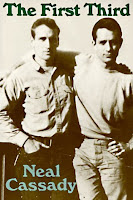


In fact, his book - "The First Third" - barely limped out of the starter's gate.

He did - nonetheless - have a major influence on Kerouac's writing style.

In fact, informed sources contend that Cassady's conversational style of writing inspired Kerouac to adopt a similar one.


It is a well-documented fact that a number of passages from Cassady's literary work were actually lifted and transplanted verbatim into Kerouac's legendary tome - "On the Road" - without any credit to Cassady.

What's a bit of prose between friends?

In addition to his fondness for mind-expanding drugs, Cassady was quite the womanizer, too.

Oh, he loved the ladies, alright. And they, him.

Hinkle theorized there must be a hormone or something in the brain that caused a man to be unsatisfied when it came to sex - and that Cassady - was surely inflicted with the ailment.

Quite the understatement.

Cassady also had a knack for attracting men of influence and power into his sphere, too.

In this respect, he was quite pragmatic, allegedly.

Sexual favors for the keys to the Kingdom, perhaps?

Celebrated Poet - Allen Ginsberg - was quite smitten, for starters.

In fact - according to eyewitness reports - the odd bedfellows ended up in the sack together shortly after first meeting.

The encounter was later recalled in sexually-graphic detail in Ginsberg's memorable poem, "Many Loves".

After the tryst, Cassady allegedly penned a note to Ginsberg, which read:

"I dislike homosexual sex, but affected lust as compensation for all you have given me."

Actually, Ginsberg was allegedly greatly troubled by the weekend sex romp.

In a January 21st entry in his 1947 Journal, he expressed his dismay about the possibility of becoming an "outcast" in the event he pursued a homosexual lifestyle. (!)

Was this the man who wrote two of the most shocking lines of verse I ever read at the age of 13?

"Your co** is holy. Your a** is holy."

His father recommended therapy, but after a lot of emotional turmoil and soul-searching, Ginsberg eventually adjusted and became a liberated openly-gay man years later.

Kerouac noted of the meeting between Cassady and Ginsberg:

"Two keen minds that they are, they took to each other at the drop of hat. The holy con-man with shining mind and the sorrowful poetic con-man with dark mind."

Dark was a good way to describe Cassady; often in trouble with the law - busted on several occasions for taking joyrides in stolen cars - he was a man who exorcised many demons.

A bust for an alleged sale of marijuana landed him in State Prison for a couple of years.

According to Hinkle, it was a bum rap.

"A couple of crooked narcotics guys set him up. He could of gotten off, maybe, if he fought it. After all, there was no evidence. Cassady smoked the joint with the undercover officers."

The audience roared!

While in the slammer, a number of long-winded letters he wrote to family and friends - which were later published in total - revealed many intriguing aspects of his personality in fascinating multi-faceted ultra-mystical detail.

At least one member of the press managed to gain entrance to his cell during the incarceration and subsequently held court with the man (Cassady) that Kerouac wholeheartedly alleged:

"Was caught up in the mystical madness of the moment."

During the interview, Al Aronwitz - who was penning a series of articles on the "Beat Generation" for the New York Post - was taken aback when Cassady proceeded to distance himself from Kerouac.

"We drifted apart over the years," Cassady casually quipped.

"He became a Buddhist and I a Cayceite," Cassady added, nonplussed.

As to the "Beat" generation, he described the experience this way:

"Beat means beatific - short for beatific vision - you know. The higher vision you can get. A shortcut is marijuana."

During that revealing session, Cassady expounded on some of the mystical views that he gleaned from the Edgar Cayce spiritual experience - garbled - though they were.

"Trouble with me is that I am living on the four lower glands and haven't opened up the higher three ones. The pituitary and endorphin glands are centers of the force," he stated matter-of-fact.

He proceeded to ramble on about the law (spiritual) and the absolute necessity of being a "channel of service".

"Self is a great sin," he noted.

Ironic, in view of how he lived - selfishly.

"The thing is to get the Kundalini fire to come up the spine into the pineal," he asserted.

Here, it was evident that a little knowledge was clearly dangerous.

In the Yoga tradition, the Kundalini is described best as a sort-of "serpent-like force" that rises up the spine.

But, it does not halt where Cassady surmised.

In fact, the Kundalini energy referred to, instantaneously surges on up to the Crown Chakra - at which point - the dedicated Yogi practitioner seeks to connect with the Divine Light.

Obviously, Cassady was misguided, had taken a half-assed approach - and ultimately - was confused about the whole process of enlightenment.

In sum, this was the story of his life.

In a talk the following night at the Beat Museum, his son recalled his father being incredibly knowledgeable about "everything".

Clearly, the young man - out of respect for his father - was inclined to wear rose-colored glasses in this instant case.

The fact Cassady's letters are rife with spelling and grammatical errors are a sure-fire indicator that something was amiss. The man had spirit - a deep soul, even - but was not terribly well-educated.

As a result, the poet was limited in his reach.

And, this hindered his ability to grasp the brass ring.

Similar shortcomings extended to the core of his very being.

It has been said he lived in the - "mad mystical moment" - with the ultimate aim of realizing the full potential of existence.

For starters - a mystical moment should never be "mad" - it should be crystal clear.

For Cassady, a focus on the "moment", was obviously a ploy to prolong a night he didn't want to end.

Anyone familiar with Buddhism is keenly aware of the fact there must be balance and harmony in an individual's life.

On the path, it is essential to be mindful of the Yin and the Yang and the natural flow of things.

In essence, because of the way Cassady mishandled "energy", the life was drained right out of him.

Subsequently, he ended up by a railroad track, like an empty bottle - spent.

Over time - Kerouac, Cassady, Ginsberg, and William Burroughs - became known as the 115th Street Club.

And, in the final analysis, they were a powerful force to reckon with in literary circles at Columbia University and in the New York City publishing scene, itself.

In addition to Cassady, Ginsberg professed his love for Kerouac, as well.

Kerouac responded with what has been described by many as a "dismissive groan".

In spite of the initial rejection, Ginsberg continued to dog him, though.

One night, he attained his quest - well - sort of.

As the two strolled down a dark street, Ginsberg persuaded the object of his desire to indulge in a little sexual stimulation on the street in a truck lot beneath the elevated West Parkway near Christopher Street in the village.

Allegedly, they mutually masturbated under a starry night.

How romantic!

In retrospect, it is evident that in the mercurial paths that crossed here - those of Kerouac, Cassady, Ginsberg, and Burroughs - that not only was there an instinctive take on the pulse of the cultural trends of the era by each, but also, an incestuous spark between 'em that ignited and thrust forward their collective vision into the mainstream.

On writing, Kerouac opined:

"Art is good when it springs from necessity. This kind of origin is the guarantee of value; there is no other."

In spite of this lofty beginning, gifted Truman Capote acidly remarked about Kerouac's literary style:

"It's not writing. It's typing."

In respect to race and gender, some complained that - "On the Road" - was strangely naive, hopelessly conservative, and self-destructive.

In spite of this searing criticism, Carole Volpat argued that Kerouac's writing was an achievement, and managed to:

"Provide a portrait of characters who took to the road not to find life but to leave it behind."

Although Leslie Fiedler considered the - "flight of the dreamer from drab duties of home and town a fundamental narrative pattern in American Culture" - the exercise went unrecognized by many leading literary authorities of the day.

Perhaps the issue was execution?

Melvin Askew lamented that "On the Road" was:

"A failure of artistic realization, treacherous, tedious, neither exciting, illuminating, or enduring."

Well, he was off-the-mark in one respect.

"On the Road" has endured.

Kerouac once said:

"My work comprises one vast book like Proust's except that my remembrances are written on the run instead of afterward in a sick bed."

In response, a chorus of critics were gleefully inclined to shout out:

"But, the remembrances are not factual or true."

On the subject of Kerouac, writer Ken Kesey said:

"He wrote his books not so much to tell the truth as to make truth."

Jack Kerouac considered all of the literary works he'd written as "chapters" in what he poignantly referred to as "The Duluoz Legend".

By legend, it is assumed that Kerouac believed in the transformational power of storytelling, because he allegedly told his friends that they could translate their lives into legends by committing themselves to the act of writing about what happened to them.

With that in mind - "true-story novels" - has been used as a label to describe his literary offerings.

But, fictionalized autobiographical works are difficult to pin down.

Because of their confessional nature, the tales unfold in a way that heighten the emotional content - and in the process - reveal the mysteries of inner reflection by virtue of self-examination.

"Confessional Picturesque Memories" is what they truly are, some assert.

Because "On the Road" failed to meet or fall into a transitional generic category, it was deemed a deeply flawed work.

That is the crux of it, really.

Both the form and structure were original, but in toto - "On the Road" - lay beyond the reach of critical analysis.

This accounted for its lack of recognition at the time of its original publication.

Indeed, it was snidely looked upon as a "cultural novelty" in elite literary circles.

Hollywood has attempted to capture aspects of the tale on the silver screen, without much success.

In fact, at least one such exercise caused a former wife of Kerouac to lament,

"They reversed our psyches and put words into our mouths and actions which were the antithesis of what we were and aspired to be. It was a hideous mockery of our ideals and our struggle to rise above the mediocre mindless herd instincts."

The director of the "Beat Museum" opined:

"They were artists without any agenda. The writers were not attempting to change the world, but rather, were trying to live authentically."

At the Cassady celebration, John Allen chuckled:

"The Beat Generation was all about sex, drugs, and jazz."

In recent years, many have been critical about the way the "Beat" influence has been sold; brimming with an American Bourgeoisie ethic raised to cosmic proportions.

Coppola apparently has the rights to "On the Road" and intends to shoot a version.

According to sources close to the project, he pines for unknown actors and would like to lens in black and white.

Meanwhile, the studio - within a commercial framework obviously - will strive to cast the likes of Brad Pitt and Johnny Depp in a bold-faced effort to realize the full box-office potential.

Go figure!

In the meantime, as creative powers wrestle with the challenge, the illustrious Beat Museum continues on.

The museum - in effect - houses pieces of the mysterious puzzle that was Jack Kerouac; the glue that holds the romantic ideal of the beats together for die-hard fans to glom on to.

Without doubt, there is a lot more folklore and myth afoot than meets the "eye".

But, because the beats have reached such exalted status in this country, they are untouchable in many respects.

In recent days, there has been a call to honor the Beat poets with a sidewalk tribute on Columbus and Green Streets in San Francisco's North Beach neighborhood.

The fact remains - Kerouac, Cassady, and Ginsberg - were soulful artists who breathed life into many a notion and an idea.

Sadly, they sought a truth that remains as elusive today as it was then.

Info: kerouac.com

The Chakras Cassady spoke of...


Tuesday, October 2, 2007

Chicago 10...documentary distorts truth!


Were the protests at the 1968 Political convention headed up by a band of Yippies symbolic of the conflicts of values that characterized the late sixties?

In Chicago 10, a film screened at the California Plaza recently, a rapt audience watched in awe and disgust as the documentary of the alleged events of the 1968 Political Convention in Chicago, unfolded on the screen.

Adeptly facilitating an ambitious mix of CGI animation and archival footage, Director Brett Morgan chronicled the events surrounding the incident where protesters denied permits to demonstrate, repeatedly clashed with police, and the most vocal perpetrators - Abbie Hoffman, Jerry Rubin, and others - were prosecuted eight months after the melee, pursuant to the Anti-riot Act.

The documentary has been being billed as a parable of hope, courage, and ultimate victory.

It is far from that.

Actually, it's a cautionary tale about clashing wills, human error, and blind ambition - all rolled into one.

True, some of the images are shocking - close-up shots of cops beating on peaceful demonstrators - definitely not for the squeamish.

As the character in the film - "Cool Hand Luke" - said, "What we have here is a failure to communicate".

There were a number of glaring mistakes made on both sides.

For instance, the City of Chicago should have granted the permits; after all, denying peaceable assembly in the U.S. is un-American.

But the Chicago 8 and their merry band of followers erred too; the hapless protesters should have vacated the park at 11 p.m., and postponed the event, until the proper permits were secured from the city.

Although everyone was rooting for Hoffman - myself included - it was painfully obvious from the footage that he and Rubin acted immaturely, stupidly.

What adult or teenager is not painfully aware of the consequence of disrupting a courtroom?

None of their antics in his Honor's presence or the Judicial environs contributed to the cause at all.

Yes, the Judge acted outrageously. But a complaint to the Commission on Judicial Performance, or a petition for removal from the bench - even a request for change of venue - may have been the right way to go.

Yes, Judge Hoffman (no relation to Abbie) erred, too.

Instead of denying Bobby Seale (Co-Chair of the Black Panther Party) his right to represent himself without explanation - the court would have been wiser to have followed one of two courses of action: either warn Seale about the perils of self-representation, then permitted the defendant to proceed if he elected to do so, or - taken the matter under submission, written up a legitimate ruling, citing the valid points of law, then duly noted for the record that Seale was entitled to appeal the ruling in the proper forum.

Instead, we witnessed Seale being gagged and bound to his chair after his wild, disruptive protests about rights' violations aggravated the Judge...probably one of the most shocking and blackest moments in American History.

There were a number of humorous moments in the film, too.

For instance, Allen Ginsberg appeared on the witness stand and was asked by a prosecuting attorney to explain his use of a word referred to as "um" which he used to relieve tension.

Later in the film, when the demonstrators were facing a tense situation in the march, Ginsberg is seen emoting "um" into a loudspeaker - which was hilarious.

Anyone practising Buddhism or Yoga will confirm that the sound of "om" should be a joyous sound, one that connects with the inaudible life stream; in this instant case, it was more like an off-key drone from an old test pattern on a fifties-style black and white TV.

One viewer thought the documentary was "too gimmicky".

For example, the director used CGI animation to depict the courtroom scenes.

The effect, in my estimation, was very effective for one reason: it suggested the drama unfolding in the courtroom was cartoon-like, unreal - compared to the brute reality of the archival footage of the street where heads were being cracked and bodies were being dragged into paddy wagons.

Another moviegoer pointed out that there were two events, actually.

First, there were the demonstrations at the 1968 Political Convention, then eight months later, the trial of the Chicago 8.

The way the footage was edited, reality was blurred - which poses the question - was this a clever manipulation by the director?

In fact, when a woman asked in the Q & A what his response was to claims that his movie was "agitprop", for the first time he squirmed in his chair, was at a loss for words, and struggled to respond.

As a character recently said in the movie "The Year of the Dog", "guilty".

My Art Professor told me once that when you view a work of art - be it a painting, or a film - that you must first step back and determine first what it was that "washed over" you.

In this instant case, the director used his editorial control, and seductive images, to manipulate history.

Just the facts, man.
 
coompax-digital magazine