
As I strode into the BEAT MUSEUM in North Beach and stumbled on a celebration of the life and times of Poet Neal Cassady, it struck me that on occasion an individual is where he or she is meant to be - alightin' in a hallowed space that fits snugly into the scheme of things.
Indeed, an unexpected sequence of events snuck up on me - caught me in their powerful undertow - and swept me into a poignant place.
And, in that Divine moment, it dawned on me that an underlying force was at play in my life.
As Al Hinkle, recalled golden memories of the winsome twosome - Jack Kerouac and Neal Cassady - many of the thoughts resonated deeply.
After all, at times it appeared there were messages for me written on every breath.
For example - when Mr. Hinkle (a big hulk of a man) reflected on his days on the railroad (and those of Kerouac's sporadic seasonal toil on the lines) I wistfully recalled that just a scant few months ago - a distant relative located me through the ancestry.com web site and informed me that my own forefathers were instrumental in constructing the railroad in Ireland.
Ah, synchronicity at work!
 At the urging of guests - amid the musical strains of the "Doors" in the background - Hinkle proceeded to relay one tale about the old Hudson that Kerouac once drove which has been subject matter for historians for decades.
In those days, Al laughed, features like a radio and heater were "extras" when a vehicle was purchased - and the costs were tacked on to the down payment - accordingly.
"Well, we have to have a radio," Kerouac allegedly argued.
So, that option was snapped up.
As to the warmer?
"Jack figured that since we were driving south, we didn't need a heater."
Well, that proved to be hindsight.
Hinkle fondly noted that on frightful occasion the windshield froze up - and that as a result - Kerouac's wife had to facilitate a small razor blade to scrape an opening up large for Jack to peer through into the dark stormy night to ensure safe passage.
It being Neal Cassady's birthday anniversary, understandably, the focus of the night's reminisce was on Kerouac's sidekick who was the thumbnail sketch for one of the characters - Dean Moriarty - in the celebrated book, "On the Road".
Hinkle met Neal Cassady when he was just a wee lad (about 13) at an annual Circus event at the YMCA in Denver, Colorado.
Hinkle (who was portrayed in "Road" as "Big ED Dunkel") started out by noting that because he was tall and physically capable, he was chosen as the designated "catcher" who guided performers like Cassady safely to the earth as they flew off the high wire.
That ended up being a metaphor for their relationship over the years, he joked.
"I was always 'catching' Cassady over the years," he recalled with a whimsical smile on his face.
After all, Cassady was a hell-raiser who tended to burn the candle at both ends, to his detriment.
Some tales were a tad historic.
Apparently, Cassady worked part time on the railroad with Hinkle, to supplement his income.
In fact, he was so capable at the task of "brakeman" - that on one occasion - the poet was chosen to man the train when a celebrated passenger, Dwight D. Eisenhower, boarded the train.
Eisenhower - returning home after an appearance at the Cow Palace in pretty San Francisco post-election - apparently strode through the train and offered a handshake to the two "Irishmen" whom he asserted "had things under control" on the quaint little railroad line.
If Cassady was a bit silent on the occasion it was not due to the fact he was awestruck; on the contrary, he had just inhaled on a joint and was trying his utmost to hold his breath until the entourage with the Secret Police passed by without incident.
To many - Neal Cassady was simply a hanger-on - who rode on Kerouac's coat-tails to fame.
He was infamous for "living it up" so he could write it down.
But, Cassady never achieved full status in the literary world.
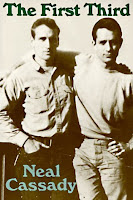 In fact, his book - "The First Third" - barely limped out of the starter's gate.
He did - nonetheless - have a major influence on Kerouac's writing style.
In fact, informed sources contend that Cassady's conversational style of writing inspired Kerouac to adopt a similar one.
It is a well-documented fact that a number of passages from Cassady's literary work were actually lifted and transplanted verbatim into Kerouac's legendary tome - "On the Road" - without any credit to Cassady.
What's a bit of prose between friends?
In addition to his fondness for mind-expanding drugs, Cassady was quite the womanizer, too.
Oh, he loved the ladies, alright. And they, him.
Hinkle theorized there must be a hormone or something in the brain that caused a man to be unsatisfied when it came to sex - and that Cassady - was surely inflicted with the ailment.
Quite the understatement.
Cassady also had a knack for attracting men of influence and power into his sphere, too.
In this respect, he was quite pragmatic, allegedly.
Sexual favors for the keys to the Kingdom, perhaps?
 Celebrated Poet - Allen Ginsberg - was quite smitten, for starters.
In fact - according to eyewitness reports - the odd bedfellows ended up in the sack together shortly after first meeting.
The encounter was later recalled in sexually-graphic detail in Ginsberg's memorable poem, "Many Loves".
After the tryst, Cassady allegedly penned a note to Ginsberg, which read:
"I dislike homosexual sex, but affected lust as compensation for all you have given me."
Actually, Ginsberg was allegedly greatly troubled by the weekend sex romp.
In a January 21st entry in his 1947 Journal, he expressed his dismay about the possibility of becoming an "outcast" in the event he pursued a homosexual lifestyle. (!)
Was this the man who wrote two of the most shocking lines of verse I ever read at the age of 13?
"Your co** is holy. Your a** is holy."
His father recommended therapy, but after a lot of emotional turmoil and soul-searching, Ginsberg eventually adjusted and became a liberated openly-gay man years later.
Kerouac noted of the meeting between Cassady and Ginsberg:
"Two keen minds that they are, they took to each other at the drop of hat. The holy con-man with shining mind and the sorrowful poetic con-man with dark mind."
Dark was a good way to describe Cassady; often in trouble with the law - busted on several occasions for taking joyrides in stolen cars - he was a man who exorcised many demons.
A bust for an alleged sale of marijuana landed him in State Prison for a couple of years.
According to Hinkle, it was a bum rap.
"A couple of crooked narcotics guys set him up. He could of gotten off, maybe, if he fought it. After all, there was no evidence. Cassady smoked the joint with the undercover officers."
The audience roared!
While in the slammer, a number of long-winded letters he wrote to family and friends - which were later published in total - revealed many intriguing aspects of his personality in fascinating multi-faceted ultra-mystical detail.
At least one member of the press managed to gain entrance to his cell during the incarceration and subsequently held court with the man (Cassady) that Kerouac wholeheartedly alleged:
"Was caught up in the mystical madness of the moment."
During the interview, Al Aronwitz - who was penning a series of articles on the "Beat Generation" for the New York Post - was taken aback when Cassady proceeded to distance himself from Kerouac.
"We drifted apart over the years," Cassady casually quipped.
"He became a Buddhist and I a Cayceite," Cassady added, nonplussed.
As to the "Beat" generation, he described the experience this way:
"Beat means beatific - short for beatific vision - you know. The higher vision you can get. A shortcut is marijuana."
During that revealing session, Cassady expounded on some of the mystical views that he gleaned from the Edgar Cayce spiritual experience - garbled - though they were.
"Trouble with me is that I am living on the four lower glands and haven't opened up the higher three ones. The pituitary and endorphin glands are centers of the force," he stated matter-of-fact.
He proceeded to ramble on about the law (spiritual) and the absolute necessity of being a "channel of service".
"Self is a great sin," he noted.
Ironic, in view of how he lived - selfishly.
"The thing is to get the Kundalini fire to come up the spine into the pineal," he asserted.
Here, it was evident that a little knowledge was clearly dangerous.
In the Yoga tradition, the Kundalini is described best as a sort-of "serpent-like force" that rises up the spine.
But, it does not halt where Cassady surmised.
In fact, the Kundalini energy referred to, instantaneously surges on up to the Crown Chakra - at which point - the dedicated Yogi practitioner seeks to connect with the Divine Light.
Obviously, Cassady was misguided, had taken a half-assed approach - and ultimately - was confused about the whole process of enlightenment.
In sum, this was the story of his life.
In a talk the following night at the Beat Museum, his son recalled his father being incredibly knowledgeable about "everything".
Clearly, the young man - out of respect for his father - was inclined to wear rose-colored glasses in this instant case.
The fact Cassady's letters are rife with spelling and grammatical errors are a sure-fire indicator that something was amiss. The man had spirit - a deep soul, even - but was not terribly well-educated.
As a result, the poet was limited in his reach.
And, this hindered his ability to grasp the brass ring.
Similar shortcomings extended to the core of his very being.
It has been said he lived in the - "mad mystical moment" - with the ultimate aim of realizing the full potential of existence.
For starters - a mystical moment should never be "mad" - it should be crystal clear.
For Cassady, a focus on the "moment", was obviously a ploy to prolong a night he didn't want to end.
Anyone familiar with Buddhism is keenly aware of the fact there must be balance and harmony in an individual's life.
On the path, it is essential to be mindful of the Yin and the Yang and the natural flow of things.
In essence, because of the way Cassady mishandled "energy", the life was drained right out of him.
Subsequently, he ended up by a railroad track, like an empty bottle - spent.
Over time - Kerouac, Cassady, Ginsberg, and William Burroughs - became known as the 115th Street Club.
And, in the final analysis, they were a powerful force to reckon with in literary circles at Columbia University and in the New York City publishing scene, itself.
In addition to Cassady, Ginsberg professed his love for Kerouac, as well.
Kerouac responded with what has been described by many as a "dismissive groan".
In spite of the initial rejection, Ginsberg continued to dog him, though.
One night, he attained his quest - well - sort of.
As the two strolled down a dark street, Ginsberg persuaded the object of his desire to indulge in a little sexual stimulation on the street in a truck lot beneath the elevated West Parkway near Christopher Street in the village.
Allegedly, they mutually masturbated under a starry night.
How romantic!
In retrospect, it is evident that in the mercurial paths that crossed here - those of Kerouac, Cassady, Ginsberg, and Burroughs - that not only was there an instinctive take on the pulse of the cultural trends of the era by each, but also, an incestuous spark between 'em that ignited and thrust forward their collective vision into the mainstream.
On writing, Kerouac opined:
"Art is good when it springs from necessity. This kind of origin is the guarantee of value; there is no other."
In spite of this lofty beginning, gifted Truman Capote acidly remarked about Kerouac's literary style:
"It's not writing. It's typing."
In respect to race and gender, some complained that - "On the Road" - was strangely naive, hopelessly conservative, and self-destructive.
In spite of this searing criticism, Carole Volpat argued that Kerouac's writing was an achievement, and managed to:
"Provide a portrait of characters who took to the road not to find life but to leave it behind."
Although Leslie Fiedler considered the - "flight of the dreamer from drab duties of home and town a fundamental narrative pattern in American Culture" - the exercise went unrecognized by many leading literary authorities of the day.
Perhaps the issue was execution?
Melvin Askew lamented that "On the Road" was:
"A failure of artistic realization, treacherous, tedious, neither exciting, illuminating, or enduring."
Well, he was off-the-mark in one respect.
"On the Road" has endured.
Kerouac once said:
"My work comprises one vast book like Proust's except that my remembrances are written on the run instead of afterward in a sick bed."
In response, a chorus of critics were gleefully inclined to shout out:
"But, the remembrances are not factual or true."
On the subject of Kerouac, writer Ken Kesey said:
"He wrote his books not so much to tell the truth as to make truth."
Jack Kerouac considered all of the literary works he'd written as "chapters" in what he poignantly referred to as "The Duluoz Legend".
By legend, it is assumed that Kerouac believed in the transformational power of storytelling, because he allegedly told his friends that they could translate their lives into legends by committing themselves to the act of writing about what happened to them.
With that in mind - "true-story novels" - has been used as a label to describe his literary offerings.
But, fictionalized autobiographical works are difficult to pin down.
Because of their confessional nature, the tales unfold in a way that heighten the emotional content - and in the process - reveal the mysteries of inner reflection by virtue of self-examination.
"Confessional Picturesque Memories" is what they truly are, some assert.
Because "On the Road" failed to meet or fall into a transitional generic category, it was deemed a deeply flawed work.
That is the crux of it, really.
Both the form and structure were original, but in toto - "On the Road" - lay beyond the reach of critical analysis.
This accounted for its lack of recognition at the time of its original publication.
Indeed, it was snidely looked upon as a "cultural novelty" in elite literary circles.
Hollywood has attempted to capture aspects of the tale on the silver screen, without much success.
In fact, at least one such exercise caused a former wife of Kerouac to lament,
"They reversed our psyches and put words into our mouths and actions which were the antithesis of what we were and aspired to be. It was a hideous mockery of our ideals and our struggle to rise above the mediocre mindless herd instincts."
The director of the "Beat Museum" opined:
"They were artists without any agenda. The writers were not attempting to change the world, but rather, were trying to live authentically."
At the Cassady celebration, John Allen chuckled:
"The Beat Generation was all about sex, drugs, and jazz."
In recent years, many have been critical about the way the "Beat" influence has been sold; brimming with an American Bourgeoisie ethic raised to cosmic proportions.
Coppola apparently has the rights to "On the Road" and intends to shoot a version.
According to sources close to the project, he pines for unknown actors and would like to lens in black and white.
Meanwhile, the studio - within a commercial framework obviously - will strive to cast the likes of Brad Pitt and Johnny Depp in a bold-faced effort to realize the full box-office potential.
Go figure!
In the meantime, as creative powers wrestle with the challenge, the illustrious Beat Museum continues on.
The museum - in effect - houses pieces of the mysterious puzzle that was Jack Kerouac; the glue that holds the romantic ideal of the beats together for die-hard fans to glom on to.
Without doubt, there is a lot more folklore and myth afoot than meets the "eye".
But, because the beats have reached such exalted status in this country, they are untouchable in many respects.
In recent days, there has been a call to honor the Beat poets with a sidewalk tribute on Columbus and Green Streets in San Francisco's North Beach neighborhood.
The fact remains - Kerouac, Cassady, and Ginsberg - were soulful artists who breathed life into many a notion and an idea.
Sadly, they sought a truth that remains as elusive today as it was then.
Info: kerouac.com

The Chakras Cassady spoke of...


