3
Showing posts with label Martin Scorsese. Show all posts

Thursday, April 14, 2011

Tribeca Film Festival...Brian Williams to interview Robert De Niro! Elton John documentary to screen! April 20th - May 1st in NYC!


To celebrate ten years of screening cutting-edge films, officials at the Tribeca Film Festival have announced they are introducing a thrilling thought-provoking "Talk" series to feature high-profile personalities in the industry.

Brian Williams, Alec Baldwin and Martin Scorsese are slated to conduct one-on-one interviews with the likes of - Robert DeNiro, Doug Liman and Souleymann Cissee respectively - at the much-anticipated Director series to be held in New York City.

The upcoming annual fest - which normally boasts packed houses - runs April 20th through May 1st in lower Manhattan.

In recent days, the organizers have also leaked out details about a handful of dazzling special events, causing a big buzz in show-biz circles.

For instance, Cameron Crowe's documentary on singer - Elton John - premieres at a free outdoor screening on April 20th at the North Cove at the World Financial Plaza.

Attendees will need TFF wristbands to be seated at the event which will be distributed to the public on a first-come first-served basis at the BMCC Tribeca Performing Arts Center on April 20 at 4 pm..

"The Union" is a behind-the-scenes snapshot of the "out" Diva - who recently recorded his latest album - as a collaborative musical effort alongside legendary rock 'n roller (and good friend) multi-talented Leon Russell.

Producers are hailing the flick as an extraordinary journey of the heart which captures a "candid portrait" of one of the world's most-treasured enduring artists.

“Cameron Crowe gives audiences unprecedented access to Elton John and Leon Russell’s artistic process in an emotional and realistic way," one festival biggie enthused at a recent press junket.

Award-winning T-Bone Burnett took on the role of studio producer and nurtured the eclectic recording project to completion in recent days.

Lyricist Bernie Taupin, Neil Young, Brian Wilson, legendary R & B organist Booker T. Jones, and steel guitarist Robert Randolph (in addition to a 10-piece gospel choir) are also showcased on the much-touted album.

At press time, it was announced that Elton will take the stage after the screening of the insightful documentary and perform a tune or two with celebrated friends in tow.

"It’s a special opportunity to open our 10th Festival in a distinct and unique way. Not only are we inviting the community to join us for the world premiere of Cameron Crowe’s film - "The Union" - but to have Elton, whose music transcends generations, perform after is an extraordinary gift to our Festival and more specifically the downtown community,” gushed Jane Rosenthal, co-founder of the Tribeca Film Festival.

Crowe sang Elton John's praises, too.

"As a longtime fan of both artists, it was a pleasure to spend a year filming their collaboration,” said Cameron Crowe.

“We can't wait to show it to one of the greatest audiences in the world at the Tribeca Film Festival," Cameron crowed to all within earshot.

In addition, the "Tribeca Talks" showcase five new documentary titles, which feature lively discussion panels with a spotlight on the likes of actor/director Sean Penn and top vocalist Harry Belafonte, for example.

Five of the documentary titles are - "The Education of Dee Dee Ricks", "Love Hate Love", "Off the Rez", "Grandma, A Thousand Times", and "Sing Your Song "- all of which receive exclusive screenings as part of the Tribeca Talks "After the Movie” series.

Another one-of-a-kind world premiere event will be the screening (and in-depth examination) of the feature L.A. Noire  - which is a new interactive crime thriller being released in the spring by Rockstar Games.

A Q & A will follow a "L.A. Noire" live demonstration of the detective game (where players solve complex, historically-inspired crimes in a beautifully recreated and fully interactive rendition of 1947 Los Angeles).

Tribeca’s special events are rounded out by a handful of Tribeca/ESPN Sports Film Festival screenings which include Alex Gibney’s "Catching Hell" (about notorious Chicago Cubs fan Steve Bartman), free “Tribeca Talks: Industry” panels (designed for industry professionals to explore the ways they can use new digital platforms to advance their film projects) and “Tribeca Talks: Pen to Paper” (which are insightful panels hosted by Barnes & Noble that focus on the artistic process of screenwriting.

“We wanted to celebrate our Tenth Festival by inviting some of the finest filmmakers, media artists and actors of our time to share their insights and experiences through the Tribeca Talks series," underscored Nancy Schafer, the Executive Director of TFF.

“We have over the years established a tradition of conversations that both engage audiences in the details and revelations of contemporary film making as well as offer a perspective as to the direction and the future of storytelling and the industry. This is so much a part of what festivals can do to enrich the viewing experience for their audiences and we are proud to present this special series."

There will be quite a few world premieres to keep film buffs clucking around the circuit, too.

The world premiere of "The Education of Dee Dee Ricks" is a documentary which demonstrates how a successful businesswoman and mother’s life changed when - after being diagnosed with breast cancer - she set out to make life easier for less fortunate cancer patients.

The stirring film is followed by a conversation with Dee Dee Ricks, producer Lisa Cohen, Ralph Lauren Center for Cancer Care and Prevention founder Harold P. Freeman MD, and public health advocates.

The event is to be moderated by director Perri Peltz.

"The Beautiful Mind" screening examines the life of Nobel Prize-winning mathematician John Forbes Nash Jr. and will be followed by a panel discussion puts the glare of the spotlight on director Ron Howard, producer Brian Grazer, screenwriter Akiva Goldsman, the film’s math consultant, Dave Bayer, author Sylvia Nasar (whose book inspired the film) and theoretical physicist and mathematician Brian Greene.

The event is slated to be moderated by NPR’s Ira Flatow.

The North American documentary premiere of - "Grandma, A Thousand Times" - examines a family matriarch as she struggles to cope with the silence of her once-buzzing house and imagines what waits her beyond death.

Hosted by the Doha Tribeca Film Festival, it should be noted for the record, that the film won the Audience Award for Best Documentary Film (2010).

The screening will be followed by a discussion with director Mahmoud Kaabour on the experience of making films in the Middle East.

The world premiere of - "Love Hate Love" - is all about the difficult journeys of three families torn apart by three separate acts of terrorism - the attacks on the World Trade Center, the London bus bombing, and the Sari Club bombing in Bali - and is followed by a conversation with executive producer Sean Penn, directors Dana Nachman and Don Hardy (as well family members featured in the film which includes Liz Alderman, Steve Alderman, Esther Hyman, and Ben Tullipan).

The New York premiere of - "The Loving Story" - recounts the unknown love story of Mildred and Richard Loving (the couple behind the 1967 Supreme Court ruling overturning anti-miscegenation laws in the United States).

The stirring legal foray is followed by the appearances of director Nancy Buirski, attorney Phil Hirschkop (who represented the Lovings), Anthony Romero, and the Executive Director of the American Civil Liberties Union (who discuss the landmark case and current issues surrounding race and marriage equality).

"Off the Rez" - a world premiere event - tracks Shoni Schimmel (a Umatilla Indian and one of the best high school basketball players in the country) whose hoop dreams of being the first from her tribe to get a college scholarship are threatened after her family leaves the Umatillia Indian Reservation.

The screening is followed by a Q & A with executive producers Kelly Ripa and Mark Consuelos, director Jonathan Hock, Discovery and TLC Networks president Eileen O’Neill.

The special event is moderated by Pulitzer Prize-winning journalist - and author of Friday Night Lights - Buzz Bissinger.

The world premiere of - "Revenge of the Electric Car" - is an up-close peak behind the closed doors of - Nissan, General Motors and Tesla Motors - at a time when the major auto makers race to develop the world’s first and most economically accessible electric car.

The screeners are promoting a panel discussion to be headed up by guest speakers director Chris Paine (President and Chief Executive Officer) Nissan Motor Co. Carlos Ghosn, Tesla Motors CEO Elon Musk, and Pulitzer Prize-winning Wall Street Journal columnist Dan Neil.

The much-anticipated event is moderated by actor, writer, and director David Duchovny.

"Sing Your Song" - a New York premiere offering - is a stirring documentary that examines legendary entertainer Harry Belafonte’s continued humanitarian contributions to the arts, the U.S. Civil Rights Movement, the fight against Apartheid, combating starvation in Ethiopia, and so much more.

Harry Belafonte is scheduled to appear for a Q & A with the filmgoers who attend.

Moderated by Tavis Smiley.

To fill out the program, there will also be scintillating screenings of 11 short films which explore the contributions of women filmmakers in the canon of the American experimental avant-garde.

This program also celebrates 15 years of direct financial support for preservation of historically under-recognized films by women through the Women’s Film Preservation Fund of New York Women in Film & Television.

A discussion follows with an eclectic group of women filmmakers who helped shape avant-garde cinema.

"Digital by Design", meanwhile, focuses on a conversation with producers, filmmakers, SAP and industry executives about the emergence of online digital platforms and applications that provoke filmmakers to confront technology head-on including funding models, intellectual property management and distribution channels.

Sponsored by SAP.

Panelists that night include Richard Whittington, Senior Vice President of media and entertainment at SAP, and writer/director Edward Burns.

"Shooting Film on a Budget" is an interesting presentation on the subject of filmmaking which is understandably sponsored by Kodak.

One of the most important aspects of realizing your independent feature is determining the right look.

How will you capture your images and bring the script to the screen in a meaningful, visual way?

Filmmakers and cinematographers must consider many variables such as mood of the story, production restrictions, post work flow, etc.

Too often these important decisions are determined by the bottom line.

However, many filmmakers are able to get the most out of their budgets while still shooting film.

Kodak invites budding filmmakers to attend this event which features celebrity guests - Michael Cuesta (writer/director of Roadie) and producer Karen Chieto - to learn how they created beautiful and cost-effective cinematic narratives on film.

Also -the "Business of Entertainment" - is expected to draw large crowds.

The program will explore the trends that affect the economics of the film business and the broader entertainment industry.

This year's panel have invited leading CEOs, producers, financiers, media - and other industry leaders - who will focus on how to finance films in the 21st century.

"Are Documentary Films Changing the World?" focuses on - filmmakers, distributors and community groups - and the new trends in documentary filmmaking (such as collaborations between filmmakers and NGOs to increase distribution and influence public perception and policy).

Panelists include filmmaker Abigail Disney - and the Co-Founder of Impact Partners - Dan Cogan.

For the Internet crowd - "Amplify the Message: Social Media" - may be of particular interest.

The panel discussion focuses on how film producers and directors engage new interactive audiences through such networks as Twitter, Facebook, Tumbles, GetGlue and Foursquare (and how much of an impact social networking has on a movie’s success or failure on multiple platforms).

Moderated by Marc Schiller (the CEO and Founder of Electric Artists).

Panelists include Rider Strong, director/screenwriter of The Dungeon Master, Howard Tullman, President & CEO of Tribeca Flashpoint Media Arts Academy, and others.

The conversation will be streamed live on the Tribeca Online Film Festival website.

http://www.tribecaonline.com

Finally - "Meet the Documentary Broadcasters" - is expected to be a spirited conversation with industry broadcasters about the type of nonfiction films they’re drawn to and their thoughts on where this genre is headed.

See 'ya there!

http://www.thetattler.biz


Friday, February 19, 2010

Shutter Island...mind fu** movie! Leonardo DiCaprio excels in psycho thriller...


An old expression - "No Man is an Island" - sprang to mind at the close of the Martin Scorsese's new feature unveiled at theatres today in wide release.

Sometimes - in order  to escape with sanity intact - it is necessary to be an island unto one's self.

The film - Shutter Island - is a psychological thriller in every sense.

Without holding back (too much so, in fact) Scorsese uses a bit of directorial wizardry to snatch up  a captive audience - and then send them headlong into a twisted realm of perception - where reality and illusion are so intertwined it makes the psyche ache.

In a nutshell, Leonard DiCaprio plays a U.S. Marshall,  assigned to investigate the disappearance of a dangerous patient at a mysterious high-security medical facility.

Shortly into the first phase of his fact-finding mission, unexpected events unfolding around him, tend to trigger memories and the onslaught of vivid frightening dreams that are difficult to wrap his own head around.

Suddenly, reality as he perceives it, goes  upside-down and sideways, when a patient at the Shutter Island facility cautions him that the world he has stepped into is "nothing but a game" and - more importantly - that there is no way out (once on the island).

The tables turn, things go bump in the night, and Scorsese's cinematic offering turns into a mighty mind fu**.

To reveal anything more would be strictly taboo.

Leonardo DiCaprio returns to the big screen in a challenging role that effects a star turn for the heart-throb.

In fact, in a couple of scenes he breaks the barrier, and ends up being downright convincing in a part that would be a struggle for even the most competent actor.

In fact, around awards time next year, I expect his name will be bandied about.

Scorsese is pretty much in top form, but stoops to a bit of melodrama at times.

For instance, when the ferry boat steams across the bay to the ominous island, the soundtrack sounds somewhat reminiscent of the intense theme song from "Jaws" cranked up for maximum effect.

Yeah, folks, something bad is going to go down!

The clever director also knows where his bread is buttered, too.

For this reason, the diminuitive auteur included cheesecake footage of DiCaprio with shirt off - all buffed and sporting tats - in spite of the fact the scene was unnecessary to the plot (and basically amounted to gratuitious sexual images).

The cast of players are all excellent and well-cast in their cameo roles.

To me, the most intriguing aspect of  "Shutter Island" dangled with the doubt.

One woman quipped to her friend as she was exiting the theatre:

"They were trying to help him."

This just might be one of those big-budget Hollywood-style films that took a turn somewhere.

How often does the hero end up in the kind of end scenario depicted here?

You'll figure it out.


Wednesday, February 3, 2010

Berlin Film Festival...Leonardo DiCaprio attends debut! Ewan McGregor trots for Polanski's "Ghost Writer"...


Shutter Island a big fat flop?


In the wake of the controversy over Polanski's incarceration (and legal wrangling ongoing in the courts) industry-insiders have been biting their nails in the aftermath and wondering what to expect at the world premiere of the outcast's new release - "The Ghost Writer" - slated to be unveiled at the Berlin Festival.

Ewan McGregor and Pierce Brosnan are expected to trot the red carpet, nonetheless, scattering a little stardust in their midst.

Leonard Di Caprio will be the big draw, however, with Martin Scorsese in tow for their offering.

Unfortunately, the previews I spied at a local theatre for their latest project - Shutter Island - spelled trouble in my estimation.

We'll see!

The organizers who hand out the prestigious "Golden Bear" award each year to deserving candidates in filmdom's artistic fields of endeavour have announced that twenty features will compete for the coveted prize.

Werner Hertzog will be one of many capable jurists bestowing the honors.

The festival runs from February 11 thru February 22.

On the splashy opening night - "Apart Together" - will screen to enthusiastic audiences.

Not surprising, since director Wang Quan'an won a Golden Bear in the past  for Tuya's Marriage (2007).
The Berlin Film Festival, also known as the Berlinale, is one of the world's leading film festivals and most distinguished media events.

It is held in Berlin and has been celebrated annually since 1978.

Tickets sold to date confirm that is the largest publicly-attended film festival worldwide.

Up to 400 films are shown in several sections representing comprehensive facets of  the cinema.

In addition to the aforementioned attendees, Gerard Depardieu will honor the fest with his formidable talents, when he graces the silver screen  in a film directed by Thomas Vinterberg (Danish).

Info:

http://www.berlinale.de/en/das_festival/festivalprofil/profil_der_berlinale/index.html


Thursday, April 3, 2008

Shine a Light...Scorsese doc illuminates surface but falls short!


"Shine a Light" igniting the silver screen in IMAX is a visual experience you may not want to miss - if you're a Rolling Stones fan - in particular.

In the fast-paced documentary, with Oscar-winning Director Martin Scorsese at the helm, a penetrating lens slices through layers of the mystique with razor-sharp precision close to the bone.

But, ultimately, the doc misses its mark.

By the end of the film, Jagger remains as elusive and mysterious as ever.

But don't say Scorsese didn't try.

In an insightful effort to add a bit of depth and breadth to mix, Scorsese handily juxtaposed old news clips, with scintillating stage footage, to great effect.

After all, the mesmerizing image of Jagger - prancing, pouting and sashaying about - is still potent stuff.

By today's standards, though, Jagger pales a tad.

Indeed, a younger generation in a feeding frenzy over titillating sensual MTV images ( and used to slick choreographed numbers by boy-bands and the like) may find Jagger a bit tame.

But, the pop icon still awes.

In what amounts to a tribally-inspired sexually-charged strut - a bold-faced tease, if you like - Jagger still manages to captivate and hold the excited crowd in his thrall.

Years ago, when the celebrated Pop Icon was queried about the phenomenon of his success, Jagger (then, a doey-eyed innocent - on the surface at least - who sported a page-boy cut and fashionable tweed jacket with collar turned up, just so) opined off the cuff:

"I guess, there is a chemical reaction, of sorts."

News reels of yesteryear reveal a surprisingly down-to-earth quality and Jagger's healthy sense of humor.

For example, when Dick Cavett starts to pose a simple question - which ends up being a long-winded, confusing one - Jagger grins, shakes his head, and confesses with a sheepish look on his face.

"I've forgotten the question."

Keith Richards could be remarkably quick on the uptake, too.

When one reporter probed - What question are you asked most?" - without skipping a beat e chuckled "That one" - with a delicious smile on his face.

Given the opportunity, I'd ask Mick about his wardrobe selections.

Are they of his own choosing - conjured up with the assistance of a stylist - I wonder?

In "Shine", he sparkled and made tantalizing fashion statements.

The lead singer for the Stones - the world's "top rock band? - tends to favor elegant button down shirts in lush fabrics (oftentimes, fashioned in blood red) usually highlighted with a stylish panels adorned with sequins running down the front.

On occasion, he squeezed into a black "T" with a spray of glitter across the face - which caught the light - and subsequently dazzled.

In one shot, he looked for all-the-world like an idyllic "Prince of Pop" in a tastefully-tailored Tuxedo jacket - with ubiquitous tails and satin lapels - to boot.

A mainstay?

Black jeans, which fit snugly, and screamed out pure "sex" appeal.

At the beginning of the film, Scorsese often came across as a wise old owl perched on high from afar.

His on-the-ball crew often captured the award-winning director fussing about behind-the-scenes - and occasionally - rabble-rousing with Jagger over an issue or two.

But - when the lights went up and the show began - the camera-work was flawless and carried out to perfection.

The expert cameraman were there to catch each solo riff, or striking vocal that chimed in unexpectedly from across the stage, for instance.

In fact, the reveal was so up-close and personal now and then, that the audience caught sight of Jagger's dental work and perspiration soiling his underarms.

Back off a little, Marty.

While the cinematography was excellent for the most part, the lighting - in contrast - was not very flattering to the boys, at all.

If what they say is true - you get the face you deserve at fifty - then it applies in this instant case.

The mugs of Mick and the boys were haggard and deeply-lined; a roadmap which reflected the downside of their jet-setting, party-hearty lifestyle, eh?

One failing of the documentary?

Scorsese failed to take a foray into their backstage personas; in fact, their seemingly endless days of wine and roses and lusty pursuit of women, is left out in the cold.

Essentially, the doc is a superficial glance at Jagger and the lads.

In sum, "Shine A light" doesn't.

Perhaps, it would be more aptly titled "In Concert".

For this reason, as a whole, the audience doesn't get much satisfaction.

Scorsese directed!

Tuesday, December 4, 2007

Documentaries...propaganda or educational tool?


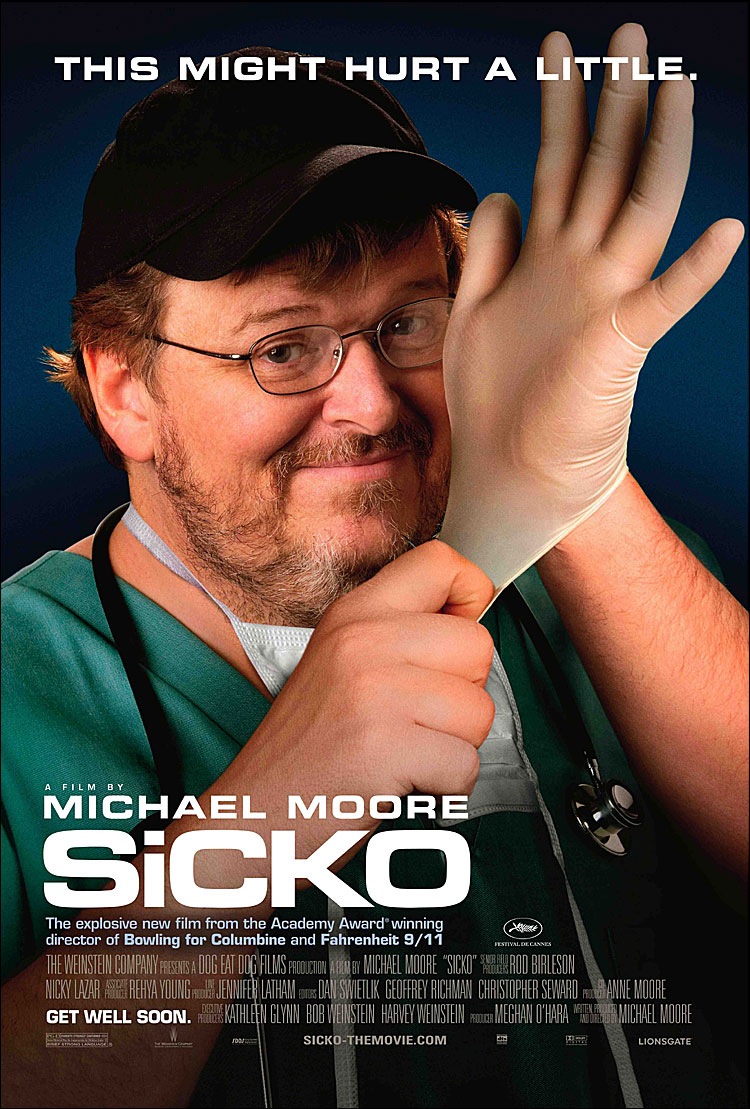
When film director Michael Moore unveiled his new documentary SiCKO - amid a lot of fanfare in earlier this year in Sacramento - some said:
"There he goes again".

Taking in a documentary is one of my favorite past-times.

Of course, the "doc" comes in all varieties. A director may focus on thought-provoking pieces about nature's astounding wonders, or take an insightful foray into an important social or political issue of the day, you name it.

In my mind's eye, when it comes to the latter, the facts should be presented fairly so that the viewer may weigh all the information - and henceforth - arrive at an intelligent reasoned decision about the issues.

For the most part, documentary filmmakers are inspired to "log" a topic because they are all fired up about a project. I mean, somethin' must have got 'em all hopped up to tackle the issues, eh?

For this reason I am inclined to believe that the creators may have a tendency to lean a little.

Undoubtedly, a subtle manipulation of the content is capable of swaying an audience in a particular way.

For instance, whether an insightful (or inflammatory) interview or news clip is placed at the beginning or end of the reel may have a dramatic impact on the viewer.

Although 60 minutes promises to follow the strict dictates of professional journalism - on occasion you can tell by the way the piece was constructed - where their loyalty falls.

One critic spouted recently that documentaries reminded him of "homework".

Joe Queenan - at the LA TIMES - recalled the empty experience of being locked in a steamy smelly auditorium forced to watch grainy films about boring topics produced by the Department of Agriculture.

"I'd rather watch the worst Keanu Reeves movie, I would rather sit through eleven consecutive Demi Moore films (are there that many?) than sit through a documentary," he noted with distaste.

Or maybe he was responding tongue-in-cheek?

No matter.

His statements caused a firestorm from the documentary camp from those who assert that this forum is where political causes, life's injustices and social ills may be brought to the fore.

June Macquire of Mission Viejo quoted Thomas Jefferson:

"If a Nation expects to be ignorant and free, in a state of civilization, it expects what never was and never will be".

Recently, I caught a couple of compelling informative documentaries.

The "Orange Chronicles", for instance.

THE ORANGE CHRONICLES is an examination of Ukraine's Orange Revolution from the perspective of an intrepid Ukrainian-American filmmaker who criss-crossed the country in the weeks before the remarkable events of 2004 as a volunteer Election Observer. The director chronicled what turned out to be a most astonishing bloodless political turnaround.


Another searing insightful documentary on "Darfur" was hosted by award-winning actress - Alfre Woodward - recently at the Fine Arts Theater.


Shortly after the screening about the "alleged genocide" in Darfur, a number of the dailies wrote bold features urging that concerned individuals take action to ensure the atrocities cease.

It helps to have an intelligent articulate public figure involved with a cause to ensure a spotlight will be thrown on the subject.

In recent months, fans of documentaries have demonstrated their loyalty by attending recent screenings at local and national theatres.

For example, the New Beverly Cinema screened a handful of rarely-seen films by one of America's greatest living directors, Martin Scorsese.

In ITALIANAMERICAN (1974, 48 minutes, color) Scorsese focused on the home of his late parents Catherin and Charles (who have appeared in Goodfellas, Mean Streets and Raging Bull). The couple discussed everything from their immigrant heritage to on-camera behavior and the family's secret spaghetti sauce recipe.

In another precious gem Scorsese introduces a main character to the tune of Bunny Berigan's - "I Can't Get Started" - and a shave turns into a musical bloodletting in THE BIG SHAVE (1968, 6 minutes, color). In essence, it's an early black comedy gem that has remained in dusty film vaults unscreened for years.

The American Film Institute got in on the screening trend this year, too, when they presented a few intelligent thought-provoking documentaries in their forum on the genre.

In the future, keep your eye out for them. They're worth catching the second time around.

LYNCH

A rare look into the psyche of the man who created Blue Velvet and ERASERHEAD, LYNCH documents the making of INLAND EMPIRE.

LYNCH talks about the beauty of discovering ideas and the struggle to unveil his cinematic vision. In this film, he is infectious and inspiring.

Hollywood Chinese

Arthur Dong critically re-examines the history of Hollywood's creation of the stereotypic Chinese identity on film. He artfully weaves together 75 years of film clips with insightful commentaries by Ang Lee, Joan Chen, James Hong - and others - who are reshaping the image of Chinese People in the cinema today.

Spine Tingler! The William Castle Story

This documentary chronicles the last great American showman, William Castle.

A master of ballyhoo - who became a brand name in movie horror with his outrageous audience participation gimmicks - Castle treated delighted moviegoers to buzzing seats, flying skeletons, luminescent ghosts and life insurance policies against "death by fright". Director Jeffrey Schwarz artfully unfolds Castle's rags-to-riches role with brio and a wealth of archival footage along with numerous interviews with the impresario's friends, family, and fans.

The Man in the Shadows: Val Lewton

Between 1942 and 1951, Val Lewton stretched his modest $125K budgets into a series of classic genre films.

Martin Scorsese and Kent James celebrate Lewton and his key team (director Jacques Tourneur, editor/director Mark Robson and writer DeWitt Bodeen) and their films which included Cat People, The Seventh Victim, and the Ghost Ship.

Monday, November 26, 2007

Martin Scorsese discusses Antonioni...and the images!


A few months ago Michelangelo Antonioni passed away and there were a number of tributes paid to the Italian Director.

Although it was a few years ago, I vividly recall a number of the scenes from the feature - "Blow Up" - which affected me greatly both personally and professionally.

The film was set in the swinging sixties in London, England.

The images in the park still resonate; in particular, those of a mime playing a surreal game of tennis which casts nagging doubts in the mind about illusion and reality.

For their day the ideas were thought-provoking and ground-breaking.

The visionary auteur was capable of going beyond boundaries - and as a result - he exacted his own inimitable style.

For this reason, he was a director's director.

Martin Scorsese was asked to reflect on Antonioni's body of work.

In a discussion on "L'Aventura", Scorsese noted:

"His visual language was keeping us focusing on the rhythm of the world: the visual rhythms of light and dark, of architectural forms, of people positioned as figures in a landscape that always seemed terrifyingly vast. And there was that tempo, which seemed to be in sync with the rhythm of time, moving slowly, inexorably, allowing what I eventually realized were the emotional shortcomings of the characters - Sandro's frustration, Claudia's self-deprecation - quietly to overwhelm them and push them into another adventure, and then another, and another."

Further, he reflected that,

"His characters floated through life, on impulse to impulse, and everything was eventually revealed as a pretext: the search was for a pretext for being together, and being together was another kind of pretext, something that shaped their lives and gave them a kind of meaning."

Scorsese emphasized that Antonioni seemed to open up new possibilities with each new unveiling. For example, he points out that the last seven minutes of L'Eclisse were even more terrifying and eloquent than the final moments of an earlier picture considered part of a trilogy.

"Antonioni brings us face to face with time and space, nothing more, nothing less. And they stare right back at us. It was frightening. It was freeing. The possibilities of cinema are endless."

According to Scorsese - Antonioni realized something extraordinary - the pain of simply being alive. And, its mystery.

Kevin Thomas, a Los Angeles Times critic, noted:

"He had the uncanny ability to capture the undercurrents of a particular time and place."

This observation was particularly true in respect to "Zabriskie Point".

At a recent screening it became painfully obvious that in contrast to "Blow Up" - which remains timeless, in many respects - "Zabriskie" appears dated and locked in some-kind-of Twilight Zone.

Undoubtedly, it's due to the fact the piece is set in the turbulent sixties.

In this instant case, Antonioni's vision was hindered by his methods - the pregnant pauses, the off-kilter slant on realism - and ultimately - Zabriskie Point sank in a sea of dashed hopes and good intentions.

A lot of style without substance!

For the most part, the camera shots tended to be gimmicky, too.

This is particularly true in respect to one scene where an architect leans back in a comfortable easy-back chair. Antonioni elected to shoot up from below - strategically setting the character within a frame of his choosing - against a startling vivid blue sky in the background.

As a result, the direction is not seamless, but glaring instead.

In a scene at the sand dunes later, clever camerwork, awesome lighting, and remarkable filmmaking technique, evoke a surreal quality to the desert which is breathtaking. Antonioni's manipulation of the senses manages to conjure up scintillating images - but without legs to stand on - they fall flat. However, the scenes are seductive, none-the-less.

In many respects - "Zabriskie Point" - appears to be an experiment.

A psychedelic one, at that.

In sum, Antonioni's intriguing message appeared to be all about the shifting states of mind that struggle for safer ground.

For a number of bang-on reasons, critics quickly panned the effort, unfortunately.

In my estimation, the obvious was overlooked for the most part.

Antonioni captured the mood of the era, and the instinct of a younger generation, seemingly so distant now.

Today, the celluloid moments - precious as they are in a biographical or historical sense - jump out like a sore thumb but are relevant none-the-less.

In sum, "Zabriskie Point" is a little clunky and unnatural in form.

But, the images are intriguing to watch.

For Scorsese they are,

"Images that continue to haunt me, inspire me. To expand my sense of what it is to be alive in the world."

Ah, there's a heightened sense of that aliveness, for sure!

 
coompax-digital magazine