slap!
Tuesday, July 5, 2011
Enlightenment...quote by Julian Ayrs!
slap!
Tuesday, March 15, 2011
Enlightenment...quote by Julian Ayrs!
Throw the clutter
Friday, June 19, 2009
Schwarzenegger...have 'ya got the ba**s?
News flashes in recent days have tended to focus on a surprising subject.
Ba**s.
Ah, the male anatomy!
For example, in my report on Chastity Bono's decision to pursue a sex-change operation, I applauded her for having the ba**s to go through with it.
Then, the following day, Schwarzenegger rustled up some controversial headlines when he special-delivered a bust (?) of a set of testicles to a political opponent in Sacramento, which included a hand-written note which teasingly taunted:
"You'll need these."
Without so much as a grunt, the gift was volleyed back into the Governor's court, thank you very much.
Understandably - the Lakers' b**s have not only been scrutinized up-close and personal on the court(and off) this season - but analyzed left, right, and center also.
Go figure!
I can't help but wonder where the spotlight will fall tomorrow.
Especially if it turns out to be a slow news day.
Haiku and the art of Zen Twittering anyone?
News at 11!

Sunday, May 4, 2008
24th Annual Asian Pacific Film Festival...Jaycee Chan & Kenneth Bi appear at screening of THE DRUMMER. A remarkable film!

"The Drummer" (which screened at the Asian Pacific Film Festival) is about a band of ZEN musicians and a troubled young man who stumbles upon their humble community in the mountains of Taiwan.
"For me," noted director Kenneth Bi,
"It began with a stage performance."
After attending a theatrical production by the world-renowned drummers, the genesis of an idea for the feature film crystallized.
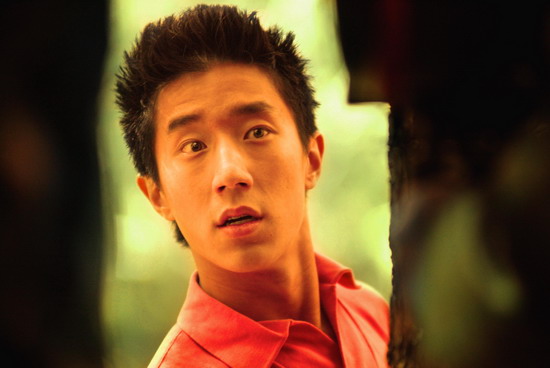
Jaycee Chan - son of famed actor Jackie Chan - adeptly plays a lost young man born into a crime family in the mean streets of Hong Kong.
When a gang war breaks out, and a bounty is placed on his head, SID flees to Taiwan to escape their wrath with the help of his father's tainted cash.
One day, the bored young man hears the sounds of drums echoing throughout the valleys of the majestic mountains, which sparks a journey up a path to their humble community.
Over the crest of a hill, he is startled to spy a serene group of men and women pounding on a set of drums in a rigorous, almost sacred manner.
He later learns they are Zen Drummers practising for an upcoming world tour.
Because Chan's character played the drums when he was a youth - mainly to vent his anger and distract himself from the painful memories of a broken home life - he strides up, cocky and full of swagger, and demands to demonstrate his skills on the skins.
When the Buddhists are hesitant to respond, he retorts like any typical spoiled American brat.
"I'll pay you."
It is quickly impressed on the lad that drum-playing is whole different musical experience in this spiritual community.
In fact, the rhythmic playing is not the "be all" and "end all" at all; but rather, part of a Zen philosophy in a holistic approach to life.
When SID begs a teacher for the chance to step forward and display his skills on the drums, a wise Master solemnly responds.
"He teaches you how to play the drums and I teach you 'how not' to."
Moments later, after beating the heck out of the skins (in what amounts to an audition) it is evident to the Masters that while SID is "talented", he is not ready spiritually to join in.
So, like a typical disciple, he is assigned various tasks designed to steer him on the right path.
In essence, he must come to understand the "hearbeat" of the mountain, the meaning of day-to-day existence - and likewise - be able to fathom the rhythms of life itself.
When the angry young man is asked to fetch water for the drummers, he is forced to walk several miles for gas when it is discovered the tank for the water-pump is empty. After a long arduous stroll to purchase the fuel, he toils with his unwelcome burden all the way back to camp.
Frustrated by these seemingly worthless annoyances, he ends up lashing out.
"I'm just a slave to you."
After all, he doesn't understand the methodology of the teacher, or the reasoning behind the daily chores.
The incident reminded me of an old proverb:t
Before enlightenment -
Chopping wood, drawing water;
After enlightenment -
Chopping wood, drawing water.
The Master then asks SID to go down to the stream and pluck up forty rocks and return to the camp with them in tow. Although bewildered by the request, he proceeds to carry out the task. When he returns with the odd assortment of pebbles, SID is then instructed to place the rubble into a satchel.
Once accomplished, he is instructed to carry the bag of stones over his shoulder wherever he journeys around the mountain each day.
For those who are familiar with practice of ZEN, the instructions of the teacher are not entirely bizarre in nature.
A Master glimpses into the soul of the disciple and assigns a koan (a puzzle) for the seeker to solve - one that is uniquely tailored to ensure a disciple's spiritual growth - with the ultimate aim of setting them squarely on their "path".
In essence, the seemingly innocuous teachings aid the student in fathoming their place in the grand scheme of things, so that they may come to know the true essence of existence on the earth plane.
Only in this way, can the mystery of the "moment" be realized.
Mr. Bi noted that when he first arrived in Taiwan, he sauntered up the mountain and stumbled across the Zen Drummers, much like the character does in the film.
"There I was in the wilderness of the mountain. At the top, when I turned and looked back, a modern city sat in the distance."
In a moment of revelation - it struck him that the "people" were living in the mountains - and that the "animals" were stalking the city below.
With powerful insight and expert storytelling techniques under his belt, Kenneth Bi manages to capture the remarkable transformation that occurs for SID on the journey from the dark underbelly of life into the Divine light of the Godhead.
Wednesday, April 30, 2008
Kenneth Bi..."The Drummer" a compelling spiritual journey. Starring Jaycee Chan!


"The Drummer" (which screened at the Asian Pacific Film Festival) is about a band of ZEN musicians and a troubled young man who stumbles upon their humble community in the mountains of Taiwan.
"For me," noted director Kenneth Bi,
"It began with a stage performance."
After attending a theatrical production by the world-renowned drummers, the genesis of an idea for the feature film crystallized.
Jaycee Chan - son of famed actor Jackie Chan - adeptly plays a lost young man born into a crime family in the mean streets of Hong Kong.
When a gang war breaks out, and a bounty is placed on his head, SID flees to Taiwan to escape their wrath with the help of his father's tainted cash.
One day, the bored young man hears the sounds of drums echoing throughout the valleys of the majestic mountains, which sparks a journey up a path to their humble community.
Over the crest of a hill, he is startled to spy a serene group of men and women pounding on a set of drums in a rigorous, almost sacred manner.
He later learns they are Zen Drummers practising for an upcoming world tour.
Because Chan's character played the drums when he was a youth - mainly to vent his anger and distract himself from the painful memories of a broken home life - he strides up, cocky and full of swagger, and demands to demonstrate his skills on the skins.
When the Buddhists are hesitant to respond, he retorts like any typical spoiled American brat.
"I'll pay you."
It is quickly impressed on the lad that drum-playing is whole different musical experience in this spiritual community.
In fact, the rhythmic playing is not the "be all" and "end all" at all; but rather, part of a Zen philosophy in a holistic approach to life.
When SID begs a teacher for the chance to step forward and display his skills on the drums, a wise Master solemnly responds.
"He teaches you how to play the drums and I teach you 'how not' to."
Moments later, after beating the heck out of the skins (in what amounts to an audition) it is evident to the Masters that while SID is "talented", he is not ready spiritually to join in.
So, like a typical disciple, he is assigned various tasks designed to steer him on the right path.
In essence, he must come to understand the "hearbeat" of the mountain, the meaning of day-to-day existence - and likewise - be able to fathom the rhythms of life itself.
When the angry young man is asked to fetch water for the drummers, he is forced to walk several miles for gas when it is discovered the tank for the water-pump is empty. After a long arduous stroll to purchase the fuel, he toils with his unwelcome burden all the way back to camp.
Frustrated by these seemingly worthless annoyances, he ends up lashing out.
"I'm just a slave to you."
After all, he doesn't understand the methodology of the teacher, or the reasoning behind the daily chores.
The incident reminded me of an old proverb:t
Before enlightenment -
Chopping wood, drawing water;
After enlightenment -
Chopping wood, drawing water.
The Master then asks SID to go down to the stream and pluck up forty rocks and return to the camp with them in tow. Although bewildered by the request, he proceeds to carry out the task. When he returns with the odd assortment of pebbles, SID is then instructed to place the rubble into a satchel.
Once accomplished, he is instructed to carry the bag of stones over his shoulder wherever he journeys around the mountain each day.
For those who are familiar with practice of ZEN, the instructions of the teacher are not entirely bizarre in nature.
A Master glimpses into the soul of the disciple and assigns a koan (a puzzle) for the seeker to solve - one that is uniquely tailored to ensure a disciple's spiritual growth - with the ultimate aim of setting them squarely on their "path".
In essence, the seemingly innocuous teachings aid the student in fathoming their place in the grand scheme of things, so that they may come to know the true essence of existence on the earth plane.
Only in this way, can the mystery of the "moment" be realized.
Mr. Bi noted that when he first arrived in Taiwan, he sauntered up the mountain and stumbled across the Zen Drummers, much like the character does in the film.
"There I was in the wilderness of the mountain. At the top, when I turned and looked back, a modern city sat in the distance."
In a moment of revelation - it struck him that the "people" were living in the mountains - and that the "animals" were stalking the city below.
With powerful insight and expert storytelling techniques under his belt, Kenneth Bi manages to capture the remarkable transformation that occurs for SID on the journey from the dark underbelly of life into the Divine light of the Godhead.
Saturday, January 26, 2008
Tetsuo...quote. Message for our times!
Zen Master Tetsuo once said,
"Be upright and honest, conscious of the principles of nature, compassionate and generous towards others, free from greed, contented. Carry out your everyday affairs correctly, without error. Take care of things without being attached to them."
Tuesday, January 8, 2008
Buddhism..."instant enlightenment"; the thought for the day!
In Buddhism, there is a term known as "Instant Enlightenment".
On occasion, an individual may be presented with a set of circumstances - on the street, in a waiting room - which require a direct response to set straight the equilibrium and return the status quo.
Usually, the problem pertains to a person and their inappropriate behavior.
"The subject in question may need to be "shaken" back into their senses and a shock is required to bring about the desired results," according to Buddhist teachers.
I've been handed the reins in a few such moments - and on those uplifting occasions - there was no need to think, or question, or dwell upon the consequence of the actions taken.
After all, a Divine Force was at work - and I was only the instrument of justice (protected by the grace of God) - called upon to act.
In the final analysis, it's good to be compassionate and to show understanding to those of lesser intelligence or lower spiritual development, but in some instances it is best to instantly enlighten the individual when they have overstepped their bounds.
Indeed, that is the natural "order" of things, and the true Master instinctively "knows" this to be a Noble, ultimate truth.
Thursday, December 20, 2007
Joshu Sasaki Roshi...Zen Master, not!
After all, Mr. Roshi is a considered one of the leading "Masters" in Zen Buddhism, today.
Each spring and fall, his followers meet at retreats - dressed in long-flowing robes, striving to attain "emptiness" - and live in the "now".
No mean feat, for a mortal man, in the Western World.
One hundred years old and in full control of his faculties - he is quite possibly one of the leading spiritual teachers in the World - alongside His Holiness the Dalai Lama
Earlier this year, I attended a retreat in San Francisco, founded by another celebrated Master (Shunryu Suzuki) - an authentic - who contributed a lot of insight into the ancient scriptures until he passed into spirit.
As I perused the article, it dredged up my own mystical experiences with a handful of the imposters, now in charge of that Buddhist center in downtown Frisco.
Yes, before I could lament - misguided meditators - I quickly discerned the Buddhist "temple" was overrun with carry-overs from the trippy-hippie age, a mishmash of displaced scary egos, and a handful of odd Zen enthusiasts who wouldn't know a "Master" if he bit them on their stuck-up noses.
When I noticed that the "alleged followers" were bent on mind-boggling, exhausting ritual - and prone to squander the precious sacred teachings in the process - I was inclined to beg the question of the chief honcho in the Buddhist residence.
Why do you bow nine times before the altar?"
"To show our respect," the disciple of the sect haughtily whispered.
"Well, you can do that with one bow," I calmly replied.
"After all," I quickly added, "Buddha was just a man, not a God.
Frankly, I doubted the "great one" would approve of their actions.
As I witnessed them sitting on their high platforms, on a multitude of plush cushions, I recalled that what I scoffed.
"The true Master sits in the lowest place."
Ah, that's when it hit me.
In the New York Times, the reporter noted that Joshu Roshi practised in the manner of the "old school".
For instance, he assigned each student a "Koan".
For example, he gifted the seeker with a baffling question pointing at some ultimate truth like, "What is the sound of one hand clapping?
Later, he allegedlyl met privately with each student four times a day, and offered up a daily lecture (teisho) from a high seat in the center of the Hall.
Yes - by virtue of the Zen teacher's actions - I was able to discern that Roshi is not the "enlightened one" he purports to be.
After all, the true "Master" squats in the lowest place, not on highest.
Funny that!
During the retreat at the Buddhist Temple up north, Master Suzuki (he wrote the best-selling book "Zen Mind, Beginner's Mind") made a revelation to me in a uniquely mystical way.
While sitting comfortably cross-legged in the meditation room one afternoon, a door - previously shut tight - sprang open and swung slowly in my direction.
Then, a voice in spirit, whispered to me at that precise moment.
"The door is open, when you're ready."
Indeed, Suzuki's presence was wandering the solemn joyless halls.
In fact, a curious phenomenon occurred at least several times a day, verifying his displeasure about what was transpiring at the center.
For example - the windows and doors slammed open and shut all hours without warning - and in furious regularity - which was an obvious omen to me.
The priests poohed poohed the idea that it was Suzuki's spirt.
"It was just the wind, " they'd insist as they looked at me askance.
But isn't Buddha also the wind?
The message was crystal clear.
Master Suzuki was angry (!) and unhappy (!) about the way the master disciples were "running" things.
I departed, the wiser - they, the sadder - for having exposed them for who and what they were...a pack of righteous phonies, without souls, caught up in the ritual of "ego", without a clue about the wondrous mysteries of Zen.
They say, when you're ready, the Master will appear.
For me, it was Christ.
For others, it may be Roshi.
If so, the cult is trying to crack the wrong "Koan".
Their spiritual leader is either a false prophet - or has a long journey ahead - to attain Buddahood.
Thursday, September 27, 2007
Peace Day, Los Angeles...Thich Nhat Hanh mindfulness walk!
On the heels of the atrocities unfolding in Mayanmar, which have shocked the sensibilities of the civilized world in recent days, Los Angeles will host a peace walk on Saturday, September 29th, 2007.
Citizens concerned about World Peace within shouting, walking, or sprinting distance, are undoubtedly planning to attend.
The march will commence at 9:30 at MacArthur Park and will be led by respected Zen Master, and honored Buddhist Spiritual Leader, Thich Nhat Hanh.
I attended the peace walk last year and it was an enlightening experience.
Shortly after the Master arrived at the podium to convey simple messages of peace, he led a contingent of young children out of the picturesque park along Wilshire Boulevard through traffic-free city streets, then back again.
The theme of the event was "peace" in every step, based on the Buddhist teaching of mindfulness.
According to Thich Nhat Hanh,
"Mindfulness is the energy of being aware and awake to the present moment. It is the continuous practice of touching life deeply in every moment of daily life. To be mindful is to be truly alive, present and at one with those around you and with what you are doing."
That day, each individual was urged to be mindful of each step planted on the earth, to breathe deeply, and focus on world peace.
As we walked for peace, there was an intense calm - and except for the occasional helicopter buzzing overhead - a profound silence which was sweet, beckoning.
Each foot - whether clad in leather, sandal, or humble sneaker - took a mindful step in unison with the other; with great accord, we were keenly aware that a mere second of life (we often take for granted in the throes of our hectic daily lives) is so precious.
When the sun broke from behind billowing clouds, and beamed down on the peace walkers, a moment of sublime joy touched each and every one.
The mystical event brought a smile to the face!
Thich Nhat Hanh was born Nguyễn Xuân Bảo in Thừa Thiên in 1926.
A graduate of Bao Quoc Buddhist Academy in Central Vietnam, Thich Nhat Hanh received training in Zen and the Mahayana school of Buddhism.
Ordained as a monk in 1949, he is now recognized as a Dharmacharya and as the Spiritual head of the Từ Hiếu Temple and associated monasteries.
According to biographers, he is the Elder of the Từ Hiếu branch of the 8th generation of the Liễu Quán lineage in the 42nd generation of the Lâm Tế Dhyana school (Lin Chi Chán 臨濟禪 in Chinese or Rinzai Zen in Japanese).
On May 1st, 1966 at Từ Hiếu Temple, Thich Nhat Hanh received the “lamp transmission”, making him a Dharmacharya or Dharma Teacher, from Master Chân Thật.
On these shores, some Buddhist precepts have baffled and confused the seeker in the modern era.
With this in mind, Thich Nhat Hanh combined his deep knowledge of a variety of traditional Zen teaching methods with methods from Theravada Buddhism and ideas from Western psychology to form his approach to modern Zen practice, popular in America today.
As a result, Thich Nhat Hanh has become an important influence in the development of Western Buddhism.
When Thich Nhat Hanh arrived in the US in 1966, his first task was to lead a symposium in Vietnamese Buddhism at Cornell University and to continue his work for peace.
For example, Thich Nhat Hanh wrote a letter to Martin Luther King, Jr. in 1965 entitled: “Searching for the Enemy of Man” and it was during his 1966 stay in the U.S. that Thich Nhat Hanh met with Martin Luther King, Jr. and urged him to publicly denounce the Vietnam War.
Dr. King gave his famous speech at the Riverside Church in New York City in 1967, wherein he publicly questioned the U.S. involvement in Vietnam.
Subsequently, later that year, Dr. King nominated Thich Nhat Hanh for the 1967 Nobel Peace Prize.
In his nomination Rev. King said,
"I do not personally know of anyone more worthy of [this prize] than this gentle monk from Vietnam. His ideas for peace, if applied, would build a monument to ecumenism, to world brotherhood, to humanity."
Without doubt, it is due to Thich Nhat Hanh's inspired method of teaching, and insightful interpretation of the scriptures, that the truth of the Masters is understood in remarkable, simplistic ways.
One of my favorite quotes,
"Looking deeply is to remove the frontier between our notions and reality."
Walk for peace, perfect peace...